

Last Updated on April 15, 2026 by Indoor Plant Nook
If you’re building or upgrading a kit, bonsai root pruning tools are where forum debates get loud: “Just buy the cheap ones—they’re all from the same factory.” Then someone posts a snapped blade and a ruined nebari.
The useful answer is more specific than either extreme. This guide explains what bonsai root pruning tools are for, how budget and premium options differ in real use, and where spending more (or less) actually pays off.
What Bonsai Root Pruning Tools Are For
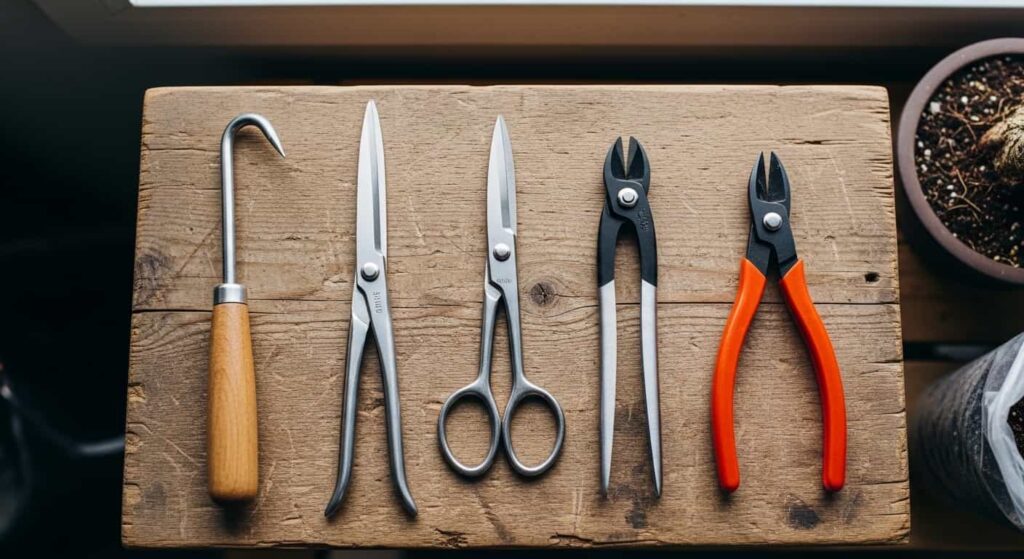
Root pruning in bonsai means trimming and restructuring roots at repotting time. The usual bonsai root pruning tools each do a distinct job:
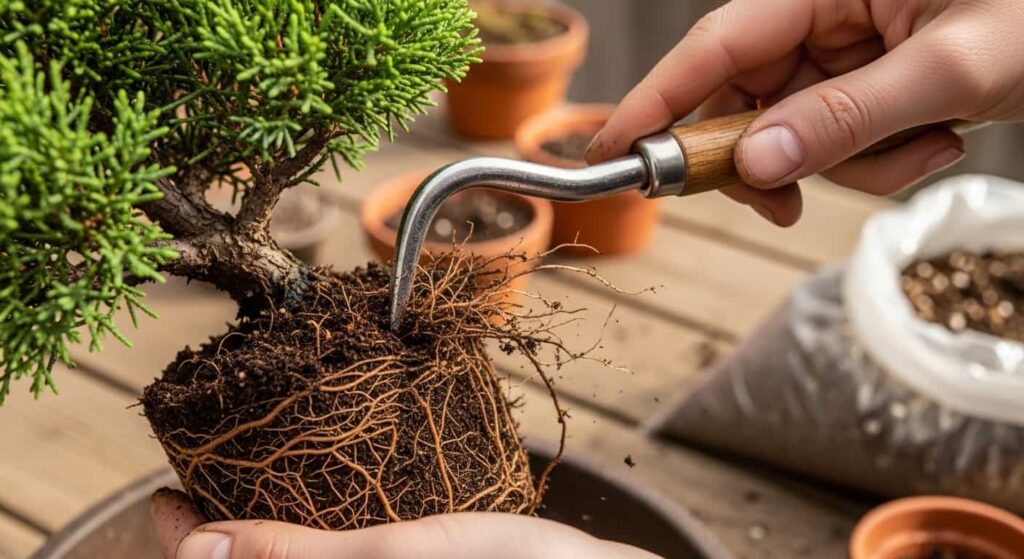
Root hooks and rakes loosen and tease apart compacted root masses when repotting. They need to flex without snapping and hold a point without bending permanently.
Root scissors (also called repotting scissors) are longer-bladed, often angled scissors designed to reach into root balls and cut through fine feeder roots cleanly. Clean cuts matter here—crushed roots invite rot.
Root cutters and knob cutters handle thicker roots, including tap roots and structural roots. These are high-leverage jaw-style cutters; blade geometry and steel hardness matter most here.
Concave branch cutters are sometimes used on surface roots where a clean, healing wound is needed—the same tool, different application.
Knowing which tool does which job is the foundation for deciding where cheap is fine and where it will cost you.
Budget vs Premium Bonsai Root Pruning Tools: What Changes
1. Steel quality and edge retention
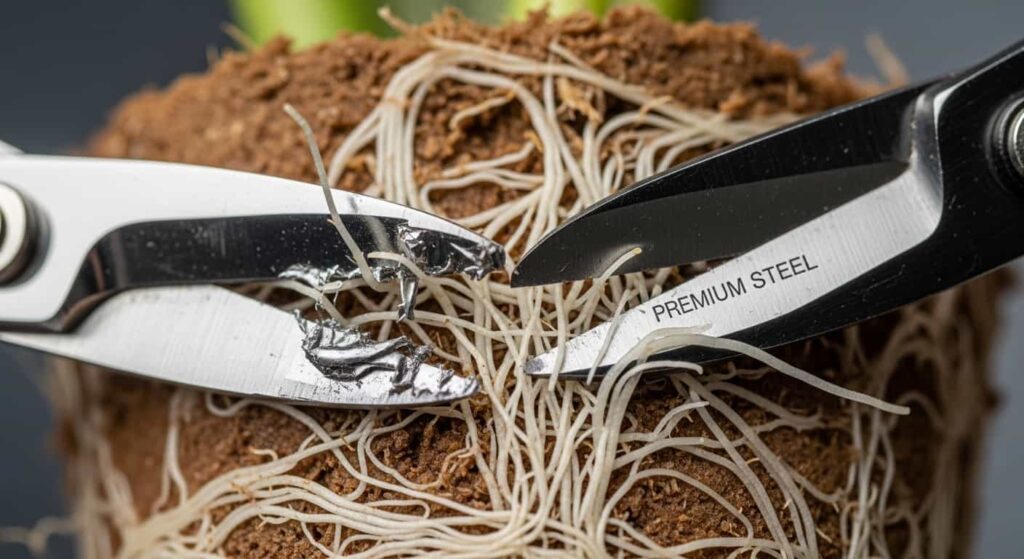
This is the single biggest functional difference and the one most worth paying attention to.
Budget bonsai root pruning tools (often $5–$20 per piece) are usually carbon steel or lower-grade stainless, hardened to roughly 52–56 HRC. They can be sharpened, but the edge dulls quickly—especially in gritty akadama-and-pumice mixes, which act like mild sandpaper on a blade.
Premium tools from makers like Masakuni, Kikuwa, or Ryuga use high-carbon or tool steel, typically hardened to 58–62 HRC. In practice, the edge lasts three to five times longer between sharpenings, and cutting through roots feels cleaner.
For root scissors in particular, edge quality maps directly to root health. A dull or cheap blade crushes root cells instead of slicing through them. That matters most on fine, hair-like feeder roots—the roots that drive recovery after repotting.
2. Pivot and hinge tolerances
Open and close a budget pair of scissors or cutters twenty times while watching the pivot. Then try a quality Japanese tool. The difference in sideways blade movement at the pivot is usually obvious.
High slop means the blades don’t stay aligned along their full length. On scissors, that produces tearing instead of cutting. On cutters, pressure spreads unevenly, which weakens cuts and wears blades unevenly.
Budget tools often have looser pivots, though not always; some mid-range pieces at $25–$40 are surprisingly tight.
Premium tools tend to ship with tight, consistent pivots. Well-made Japanese cutters feel like one rigid mechanism rather than two loose parts.
3. Handle comfort and fatigue
Repotting a large bonsai—especially one left in the same pot for years—can mean 20–40 minutes of steady cutting. Budget bonsai root pruning tools often have thinner, harder handles with less grip. Fine for a few minutes; rough on a full session with a large juniper or ficus.
Premium lines more often add ergonomic shapes, rubberized inserts, and spring returns that cut down on repeated squeeze effort. Springs make a surprisingly large difference over long sessions.
4. Durability and repairability
Budget bonsai root pruning tools are usually replace-not-repair: when a pivot rivet goes on a cheap cutter, the session is over. Premium Japanese tools are commonly serviceable—replacement springs, pivot screws, and sometimes blades—from specialty suppliers.
A $15 pair of scissors that lasts one year costs $15 per year. A $60 pair of Kikuwa scissors, maintained, can last a decade or more. Over time, that math often favors fewer, better tools.
Where Budget Bonsai Root Pruning Tools Are Enough
Not every root task needs premium steel.
Root hooks and rakes
Hooks and rakes have no cutting edge. They mainly must not take a permanent bend under normal pressure. Most mid-range hooks ($8–$15) handle soft-to-moderate root density. For very old, packed root masses—say a juniper not repotted in eight years—a stiffer premium hook is easier—but a budget hook can still do the job.
Verdict: budget is fine here, especially for beginners.
Fine root scissors on small trees
On mame to shohin trees with fine, soft roots—maples, elms, many tropicals—a sharp mid-range scissor is often enough. The mass isn’t dense enough to punish the blades, and slightly less perfect cuts matter less when the tree rebounds quickly.
Verdict: budget-to-mid-range works; a $20–$35 scissor is often sufficient.
Where Cheap Bonsai Root Pruning Tools Fall Short
Cutting large, woody roots
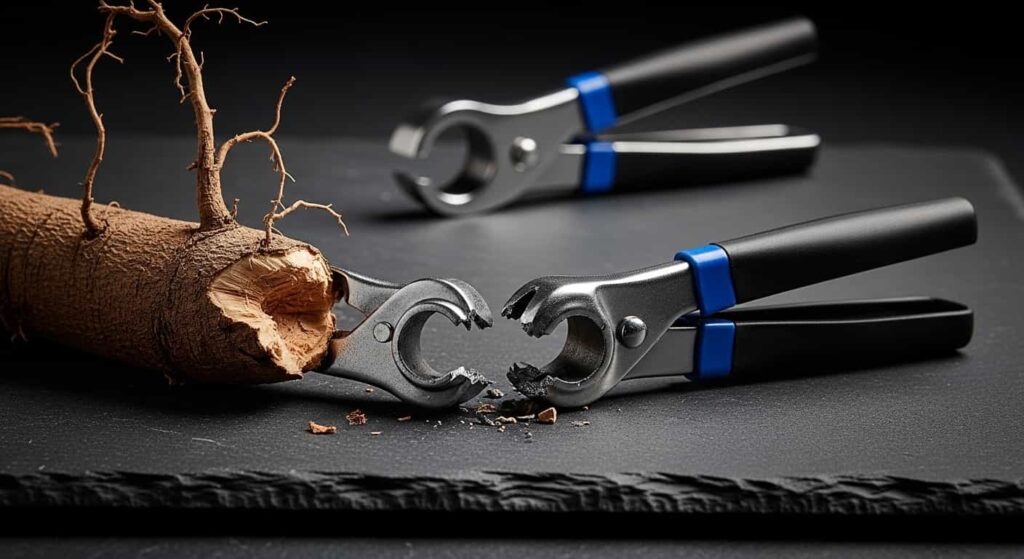
Thick tap or structural roots (about 6 mm and up) stress the blade and pivot. Budget cutters in this role may:
- Crush instead of cut (damaging cambium and inviting infection)
- Need several bites instead of one clean cut (harder on the tree and on you)
- Fail at the pivot rivet (unsafe and end of session)
For medium-to-large trees with woody roots, premium cutters—often $50–$80 from lines like Kaneshin or Green Garden—usually cut cleaner and more safely.
Verdict: don’t skimp here if your trees are past early development.
High-volume repotting
If you repot many trees each season, wear adds up: springs fail, screws loosen, alignment drifts. At that volume, premium bonsai root pruning tools tend to last long enough to justify the cost.
Verdict: go premium if repotting is a regular, high-volume task.
Comparison at a Glance
| Tool Type | Budget Range | Premium Range | Buy Budget? | Buy Premium? |
|---|---|---|---|---|
| Root hooks / rakes | $5–$15 | $30–$60 | ✅ Yes, fine for most | Only for dense root masses |
| Fine root scissors (small trees) | $15–$30 | $50–$90 | ✅ Yes, adequate | Nice upgrade, not essential |
| Root scissors (large trees) | $20–$40 | $55–$100 | ⚠️ Borderline | ✅ Recommended |
| Root cutters (thick/woody roots) | $10–$30 | $45–$120 | ❌ Risky | ✅ Strong recommendation |
| Concave cutters on surface roots | $15–$35 | $60–$150 | ⚠️ Only light use | ✅ For regular use |
Brands to Consider When Choosing Bonsai Root Pruning Tools
Budget / entry-level ($8–$35)
- Tinyroots / generic Chinese-made tools—variable quality; often passable for hooks and fine scissors
- Bonsai Boy / Joshua Roth entry sets—reasonable consistency for a starter kit
- Roshi—often stronger mid-range value at budget prices, especially scissors
Mid-range ($30–$70)
- Green Garden (Japan)—Japanese-made at accessible prices; strong value on scissors and smaller cutters
- Kaneshin entry line—reliable pivots and decent steel for the money
Premium ($60–$200+)
- Masakuni—widely regarded as a top tier for edge geometry and steel
- Kikuwa—consistent machining; strong cutter pivots
- Ryuga—newer line with solid ergonomics and modern heat treatment
How to Build Your Bonsai Root Pruning Toolkit
Match spend to tree stage and how often you repot:
If you’re starting out (roughly 1–5 trees, early development): prioritize a solid mid-range pair of root scissors and one good hook; keep an inexpensive utility cutter for rough cuts. Typical total: about $40–$70.
If you have a growing collection (about 5–15 trees, mixed sizes): upgrade the cutter to a quality Japanese model; keep mid-range scissors unless you often work trees above 10–12″ pots. Sensible upgrade band: about $80–$150 for the critical pieces.
If you own mature or high-value trees: treat root scissors and cutters as long-term investments—premium bonsai root pruning tools here reduce the risk of mangling work you can’t undo. Full premium kits often land around $200–$400+.
Maintaining Your Bonsai Root Pruning Tools
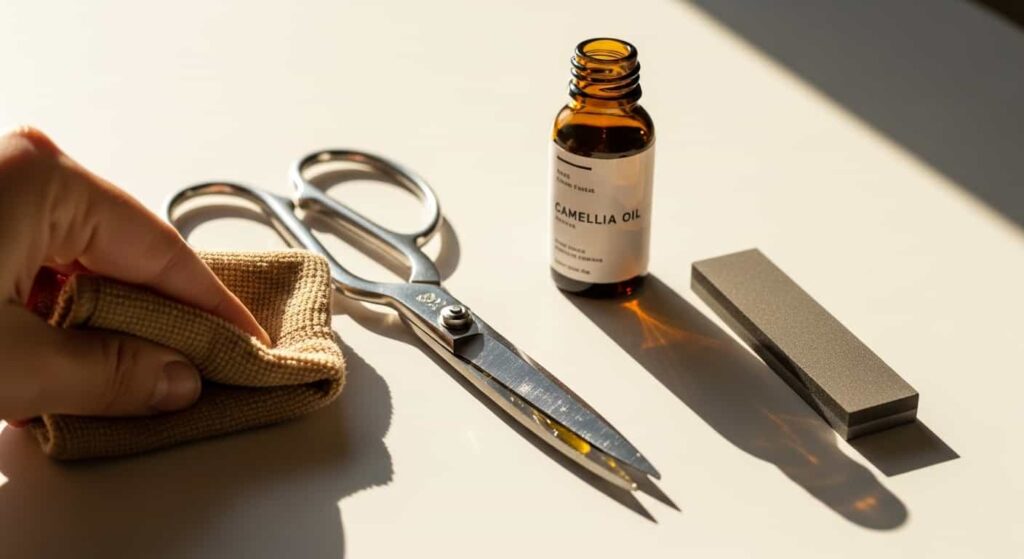
A maintained budget tool usually beats a neglected premium one. After each repotting session:
- Wipe soil and sap off blades
- Apply a light coat of camellia oil or tool oil to metal surfaces
- Tighten the pivot screw lightly if it’s accessible
- Touch up dull edges on a fine ceramic or diamond stone
With that routine, budget scissors can last years; premium bonsai root pruning tools can last decades.
Bottom Line
Do cheap bonsai root pruning tools “work”? It depends what you cut and how often.
Hooks, rakes, and fine root work on small trees are often fine on a budget. Thick woody roots and long repotting sessions are where quality shows—in your hands and in how cleanly the tree heals.
The practical approach is mixed: invest where steel and pivot quality matter most (especially cutters and scissors for heavier work), and save where simple mechanics are enough. For many growers, that means one quality cutter and one quality pair of root scissors, with budget-friendly tools filling the rest of the kit.