
Last Updated on March 16, 2026 by Indoor Plant Nook
Chinese Elm (Ulmus parvifolia) is one of the most popular bonsai species for beginners and experts alike — prized for its graceful canopy, small leaves, and forgiving nature. But even this resilient tree is not immune to root problems. When the roots suffer, the whole tree suffers. Yellowing leaves, wilting branches, and sudden dieback are almost always symptoms of something happening underground.
This guide covers every major root problem that affects Chinese Elm bonsai, how to identify each one, and what to do about it — so you can protect your tree and keep it thriving for decades.
Why Roots Matter More Than You Think
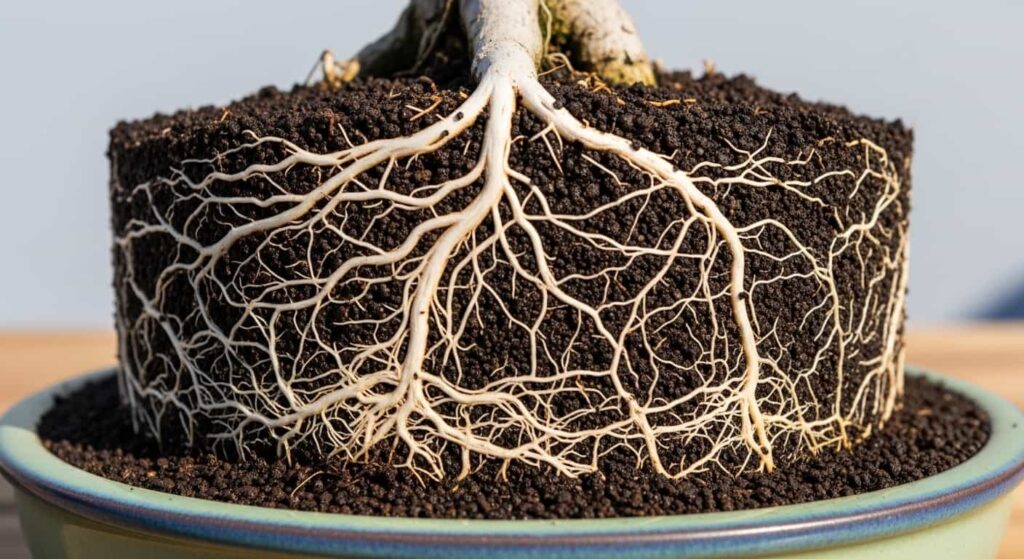
The root system is the lifeline of your bonsai. It anchors the tree, absorbs water and nutrients, and stores energy. In a confined bonsai pot, the roots live in a very small volume of soil, which makes them far more vulnerable than roots in the ground. Poor drainage, overwatering, neglected repotting, and pests can all compromise root health quickly.
Understanding root problems early — before symptoms show on the foliage — is the single most important skill in Chinese Elm bonsai care.
1. Root Rot
What It Is
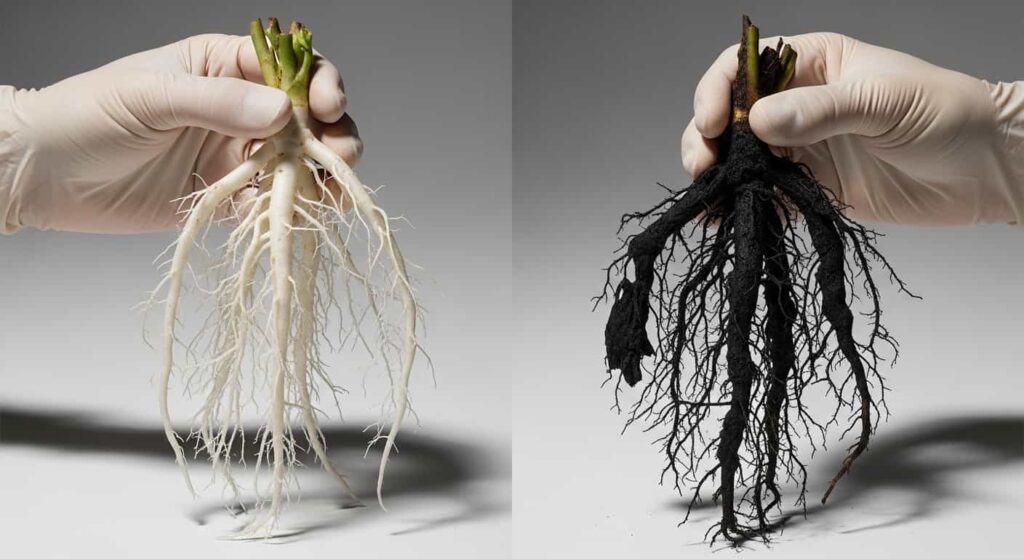
Root rot is the most common and most deadly root problem in Chinese Elm bonsai. It is caused by Phytophthora and Pythium fungi, which thrive in waterlogged, oxygen-deprived soil. When roots sit in standing water or overly compacted soil for too long, they begin to decay, turning brown or black and becoming soft and mushy.
Symptoms
- Yellowing or dropping leaves despite regular watering
- Wilting that does not recover after watering
- Black, mushy, or foul-smelling roots when you unpot the tree
- Soft, darkened base of the trunk near the soil line
- General decline in vigor and leaf size
Causes
- Overwatering or watering without checking soil moisture first
- Poor-draining soil (using garden soil or a mix that retains too much moisture)
- A pot without adequate drainage holes
- Leaving the pot sitting in a tray of standing water
- Cold, wet winters where the soil stays soggy for extended periods
Solutions
Step 1: Act immediately. Remove the tree from its pot and gently shake off the old soil. Inspect the roots carefully.
Step 2: Prune the rotten roots. Using sterile scissors or root shears, cut away all black, mushy, or soft roots back to healthy white or tan tissue. Sterilize your tools between cuts with rubbing alcohol.
Step 3: Treat with fungicide. Soak the remaining root mass in a diluted fungicide solution (copper-based or a product containing mancozeb) for 20–30 minutes to kill remaining fungal spores.
Step 4: Repot in a fresh, well-draining mix. Use an akadama and pumice blend (roughly 60% akadama, 40% pumice or grit). Avoid peat-heavy mixes that hold moisture.
Step 5: Adjust your watering habits. Water only when the top layer of soil is slightly dry. Always water thoroughly until it drains from the bottom, then do not water again until needed.
Step 6: Place in a sheltered spot. After root surgery, keep the tree out of direct sun and strong wind for 2–4 weeks while it recovers.
2. Root Bound (Pot Bound)
What It Is
A root-bound Chinese Elm is one where the roots have filled the pot, circling around the edges and even escaping through the drainage holes. There is no longer enough soil to hold adequate moisture or nutrients, and the roots begin to strangle each other.
Symptoms
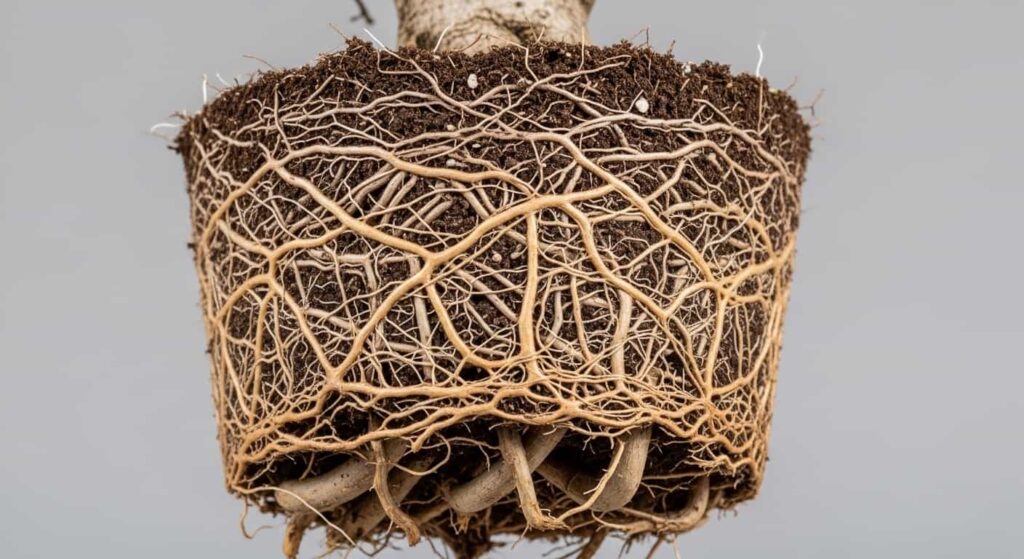
- Roots are visibly circling the inside of the pot or growing out of the drainage holes.
- Soil drying out very quickly after watering — sometimes within a day
- Stunted growth despite adequate fertilizing and watering
- Smaller leaves than normal
- Reduced back-budding and weak new shoots
Causes
- Simply not repotting often enough. Chinese Elm bonsai typically need repotting every 1–3 years, depending on the age and size of the tree. Young, vigorous trees may need repotting annually.
Solutions
Repot during early spring, just as the buds are beginning to swell but before leaves open. This is the ideal window because the tree’s energy is focused on new growth, and recovery is fastest.
Steps for repotting:
- Remove the tree from its pot.
- Gently tease out the roots with a root hook or chopstick, working from the outside inward.
- Prune back the roots by up to one-third of the total root mass, focusing on long, circling roots and thick downward roots. Preserve the fine feeder roots as much as possible.
- Clean the pot thoroughly or choose a new one with good drainage.
- Add a fresh layer of bonsai soil, position the tree, and work new soil in around the roots, eliminating air pockets.
- Water thoroughly and place in a sheltered location for 3–4 weeks.
3. Root Freeze Damage
What It Is
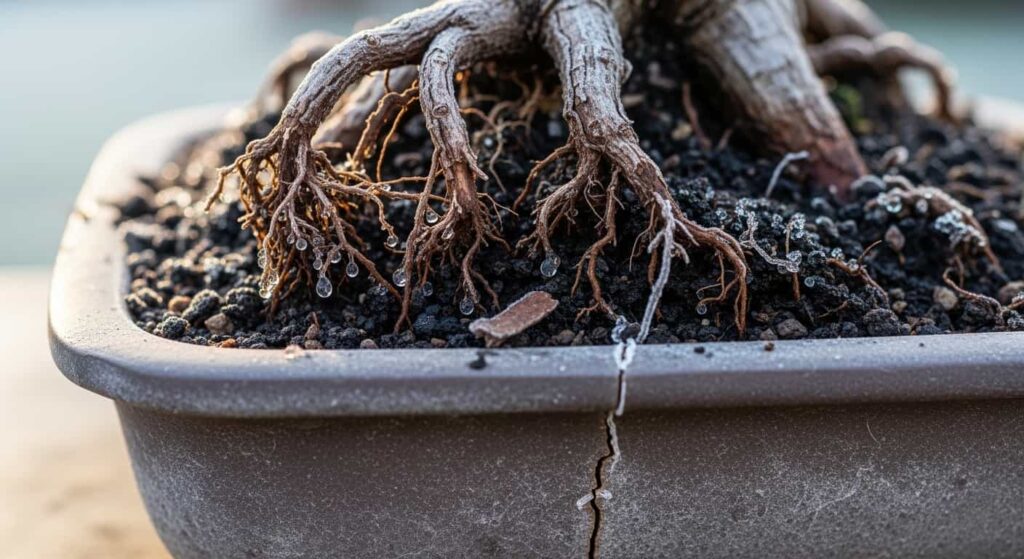
Chinese Elm bonsai are moderately cold-hardy, but their roots — held in a small, exposed pot above ground — are far more vulnerable to freezing temperatures than roots would be in the ground. When the soil freezes solid in the pot, root cells rupture and die.
Symptoms
- Failure to leaf out in spring, or very sparse, weak leaf emergence
- Dark, papery-looking roots that crumble when touched after thawing
- No signs of rot smell, but the roots are clearly dead
- Possible dieback of branches that were healthy the previous season
Causes
- Leaving a bonsai pot fully exposed to freezing temperatures in winter
- Pots are cracking due to freezing, which disrupts the root system
- Wet-then-freeze cycles, where saturated soil expands and damages roots
Solutions
Prevention is far easier than treatment. Protect your Chinese Elm in winter by:
- Moving it into an unheated greenhouse, garage, or cold frame where temperatures stay above -5°C (23°F)
- Wrapping the pot (not the foliage) in horticultural fleece or bubble wrap during hard freezes
- Placing the pot on insulating material (foam, wood) to reduce cold transfer from the ground
If freeze damage has occurred:
- Wait until all danger of frost has passed before assessing damage fully.
- Unpot the tree in early spring and cut back all dead root tissue to healthy growth.
- Repot into fresh soil and water sparingly at first — dead roots cannot absorb water, so overwatering can compound the damage.
- Prune back the canopy proportionally to compensate for lost root mass.
4. Root Pests
What They Are
Several soil-dwelling insects and organisms can attack the roots of a Chinese Elm bonsai, feeding on root tissue and creating entry points for disease.
Common Root Pests
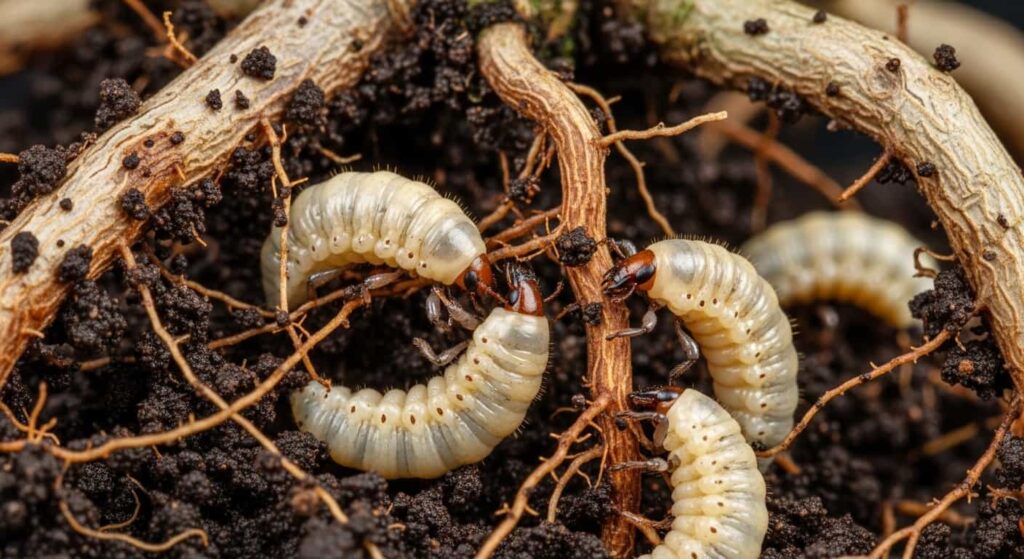
Vine Weevil Larvae (*Otiorhynchus sulcatus*): Cream-colored, C-shaped grubs that feed on roots just below the soil surface. They are one of the most destructive bonsai root pests.
Fungus Gnats (*Bradysia* spp.): The adult gnats are harmless, but their larvae feed on fine feeder roots and organic matter in the soil, weakening the tree and spreading fungal disease.
Root Aphids: Less common than leaf aphids but present in some regions. They cluster on roots and extract sap, causing wilting and stunted growth similar to drought stress.
Nematodes (Root-knot): Microscopic roundworms that cause gall formations on the roots, disrupting water and nutrient uptake.
Symptoms
- Unexplained wilting or decline despite correct watering
- Tiny flies hovering around the soil (fungus gnats)
- Notched leaf edges (a signature sign of adult vine weevils feeding at night)
- Gall-like swellings on roots upon inspection
Solutions
- For vine weevil larvae: Apply beneficial nematodes (Steinernema kraussei or Heterorhabditis bacteriophora) to moist soil in spring or autumn. They seek out and kill larvae without harming the tree.
- For fungus gnats: Allow the top layer of soil to dry out between waterings — larvae cannot survive in dry conditions. Yellow sticky traps catch adults. A top dressing of coarse grit discourages egg-laying.
- For root aphids: Unpot the tree, wash off all soil, and treat roots with a diluted neem oil solution or insecticidal soap before repotting in fresh soil.
- For nematodes: There is no perfect cure; prevention through good soil hygiene and using sterilized bonsai media is the best approach. Severely affected roots should be removed.
5. Surface Root Problems (Nebari Issues)
What It Is
The nebari — the surface roots that flare out at the base of the trunk — is a key aesthetic element of bonsai. Chinese Elm can develop excellent nebari, but several problems can mar it: crossing roots, downward-plunging roots, one-sided root development, and roots that fuse unevenly.
Symptoms

- Roots crossing over each other at the base of the trunk, creating unsightly lumps.
- One side of the nebari is well-developed; the other side is bare
- Roots that dive straight down rather than spreading laterally
- Roots that have fused into a mass rather than individual, elegant, radiating roots
Solutions
Crossing roots: During repotting, gently separate crossing roots and redirect them. If they have already grafted together, carefully score between them with a sharp knife to prevent further fusion, or accept the feature if it is minor.
One-sided nebari: Encourage root growth on the weaker side by slightly tilting the pot during the growing season so the weak side is lowest — moisture accumulates there, encouraging root growth. You can also cut back strong roots on the dominant side to redirect energy.
Downward roots: At each repotting, identify roots that grow straight down and shorten them significantly. Place a piece of mesh or a flat slate stone under the root ball to encourage lateral spread.
Developing nebari from scratch: When repotting a young tree, spread the roots outward over a cone of soil and pot at a slightly raised position. Use the “tourniquet” technique — wrapping copper wire around the base of the trunk for a season encourages a flare — but monitor carefully to prevent wire bite.
6. Dry Root Death (Desiccation)
What It Is
The opposite of root rot, desiccation occurs when roots dry out completely — either from underwatering, from repotting without enough aftercare, or from the pot being placed in a very hot, sunny, or windy spot where the soil dries faster than it can be replenished.
Symptoms
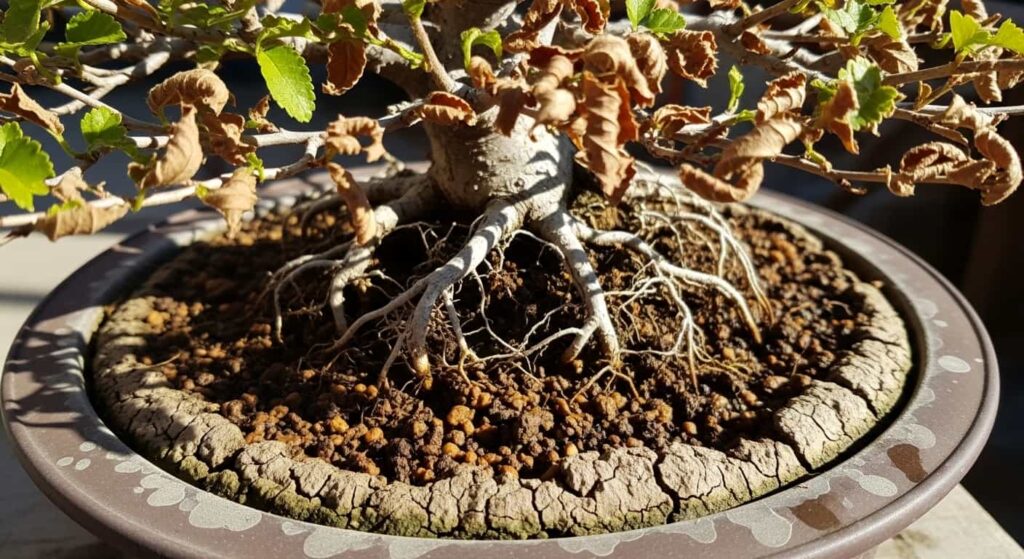
- Dry, brittle roots that snap easily rather than bend
- Soil pulling away from the sides of the pot (shrinkage)
- Leaves curling, crisping at the edges, and dropping
- Bark on the trunk and branches that appears shrunken or wrinkled
Solutions
- For mild dehydration: Submerge the entire pot in a basin of water for 20–30 minutes to allow the soil and roots to fully rehydrate. This is more effective than surface watering when the soil has become hydrophobic.
- For severe desiccation after repotting: Mist the root mass with water while repotting and keep the tree in a humid, sheltered environment afterward.
- Prevent future desiccation: Check soil moisture daily during summer. Use a humidity tray or automated watering system if you travel. Consider adding a small amount of water-retentive material (akadama holds some moisture well) to your soil mix.
7. Root Problems After Repotting
What It Is
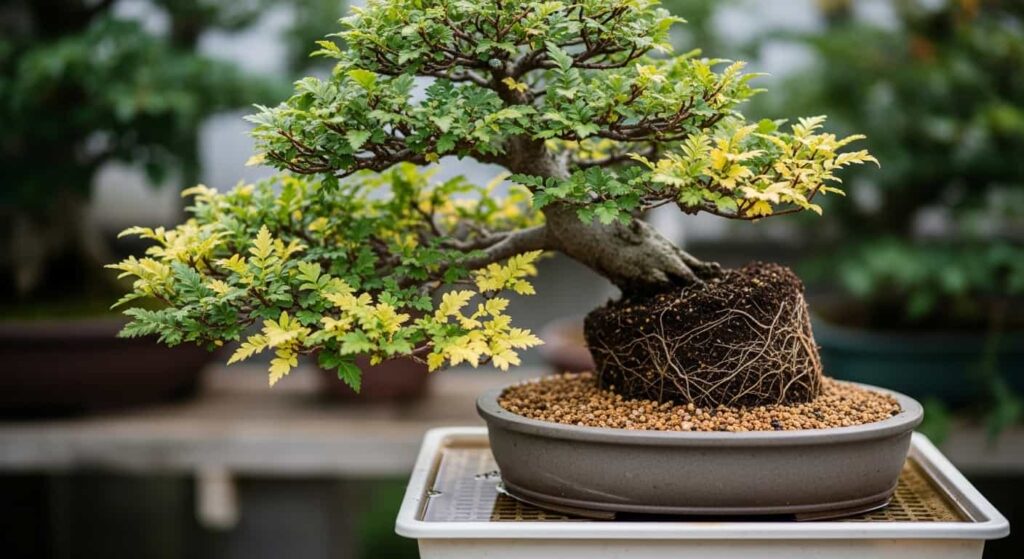
Repotting is necessary and beneficial, but it temporarily stresses the root system. Shock can cause leaf drop, wilting, and vulnerability to disease in the weeks following repotting.
Symptoms
- Sudden leaf drop days after repotting (even healthy leaves)
- Wilting despite moist soil
- Very slow recovery and little new growth
Solutions
- Reduce leaf mass at the time of repotting to balance with the reduced root mass. Remove approximately the same proportion of foliage as you removed roots.
- Never repot and fertilize at the same time. Fertilizer on damaged root tips causes a chemical burn. Wait until the tree shows healthy new growth (usually 4–6 weeks) before resuming fertilization.
- Shelter the tree. Keep it out of full sun, strong wind, and frost for at least 3–4 weeks post-repotting.
- Water carefully. Damaged roots absorb less water, so they maintain moisture without saturating the soil.
Best Practices for Healthy Chinese Elm Roots
Preventing root problems is far less stressful — for you and your tree — than treating them. Build these habits into your routine:

Soil: Use a free-draining, inorganic-heavy bonsai mix. A blend of 60% akadama and 40% pumice or coarse grit works well for Chinese Elm. Never use garden soil or multipurpose compost alone.
Watering: Water thoroughly when the soil is approaching dryness, not on a fixed schedule. In summer, this may mean daily; in winter, much less frequently.
Repotting schedule: Repot young Chinese Elms every 1–2 years in early spring. Mature trees can go 2–3 years between repottings. Always check the root mass annually by gently lifting the tree to see root density.
Pot selection: Use a pot with multiple drainage holes. Ensure drainage holes are not blocked. Raise the pot on its feet so water drains freely.
Seasonal protection: Protect the pot from freezing temperatures in winter. Bring inside a cold (but frost-free) structure when temperatures drop below -5°C (23°F).
Sterilize tools: Always use clean, sharp tools when working on roots to prevent introducing infection.
When to Call It a Loss

Sometimes, root damage is too extensive to save a tree. If more than 70–80% of the root system is rotten, frozen, or otherwise dead, recovery is extremely unlikely. In these cases, consider taking cuttings from any surviving healthy branches to propagate new trees before the parent tree dies completely. Chinese Elm roots very readily from cuttings, giving you a fresh start from your original tree’s genetics.
Final Thoughts
Chinese Elm bonsai are wonderfully tough trees, but they depend on you to provide the conditions their roots need to thrive. Most root problems stem from one of two causes: too much water or not enough repotting. Address those two fundamentals, inspect your roots at every repotting, and your Chinese Elm will reward you with decades of beauty.
The roots are invisible, but they tell the whole story of your tree’s health. Learn to read them, and you will never lose a Chinese Elm to a preventable problem again.