
Last Updated on April 15, 2026 by Indoor Plant Nook
If you’ve ever repotted a bonsai and found yourself pulling, tearing, or guessing your way through a tangled root ball, you already know the problem. Most beginners treat root work as an afterthought. Learning how to use a bonsai root hook properly—angle, pressure, and sequence—matters as much as choosing the tool itself.
A bonsai root hook loosens and separates roots instead of cutting them. This article walks you through a practical repotting workflow: how to use each style of hook at the right moment, what to avoid, and how to match the tool to the task so you keep feeder roots intact.
What a bonsai root hook does (and why technique matters)
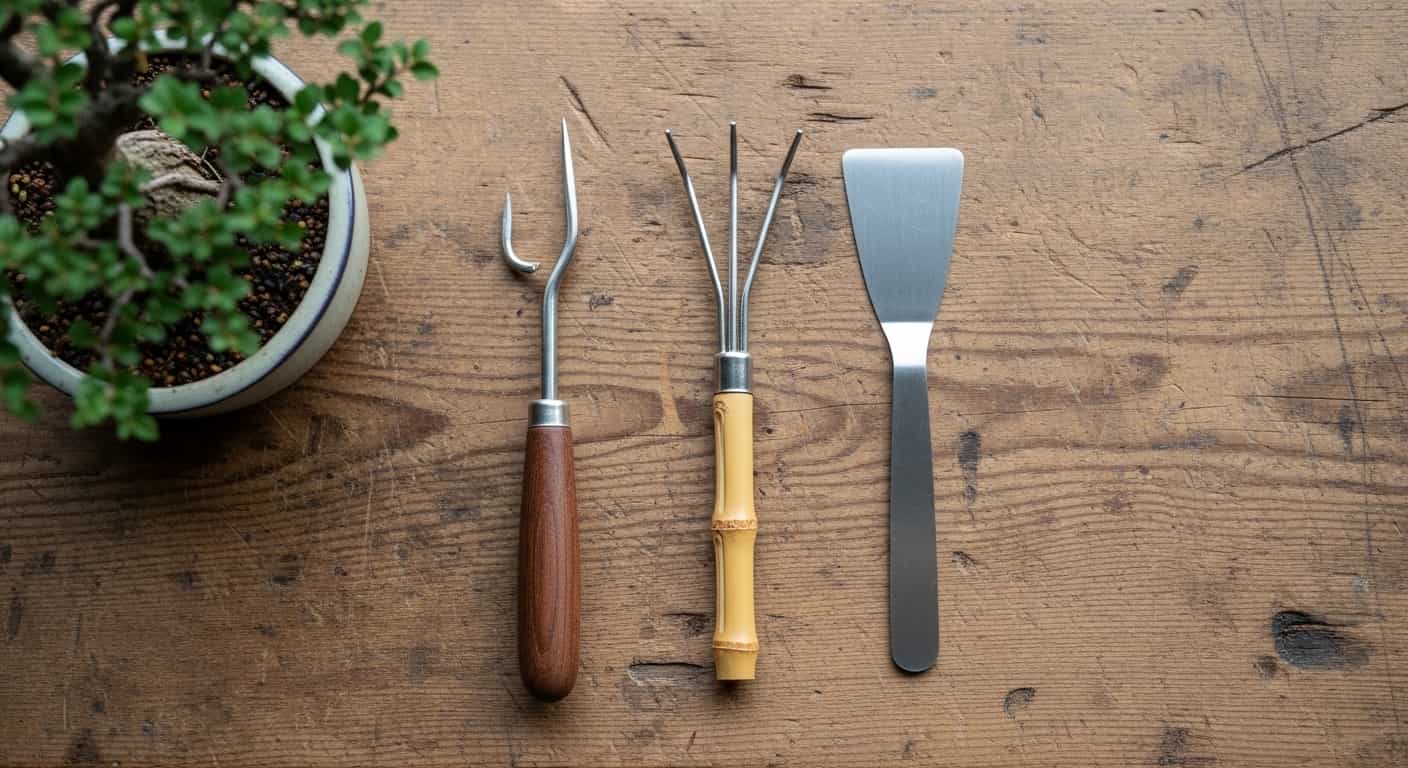
A bonsai root hook is a hand tool with one or more curved metal tines on a handle. You use it to untangle, comb, and separate roots during repotting without tearing or cutting more than necessary.
Unlike scissors or shears, a root hook loosens. It pulls away old soil, separates compacted roots, and lets you inspect the nebari (surface root spread) before you decide what to cut.
Used with the right motion and the right hook for each stage, root work:
- Preserves fine feeder roots that absorb water and nutrients
- Lets you inspect and spread the nebari cleanly
- Reduces transplant shock
- Speeds up repotting compared to working by hand alone
The wrong tool for the stage—or the right tool with too much force—can rip root masses and set the tree back for months. The sections below focus on how to use a bonsai root hook through a typical repot, step by step.
How to use a bonsai root hook: the repotting sequence
Think of root hook work as a sequence: free the root ball from the pot, remove bulk soil, comb and untangle, then refine. Heavy pressure comes early on dense soil; light, precise strokes come last near the trunk.
General technique: work from the outside of the root ball inward. Use the tips of the tines to tease soil and roots apart—pull and comb, don’t stab or lever like a crowbar. Keep the hook moving; if something resists, change angle or switch to a tool with more tines before you force a single tine through a mat.
Step 1: Free the root ball from the pot (flat hook / spatula)
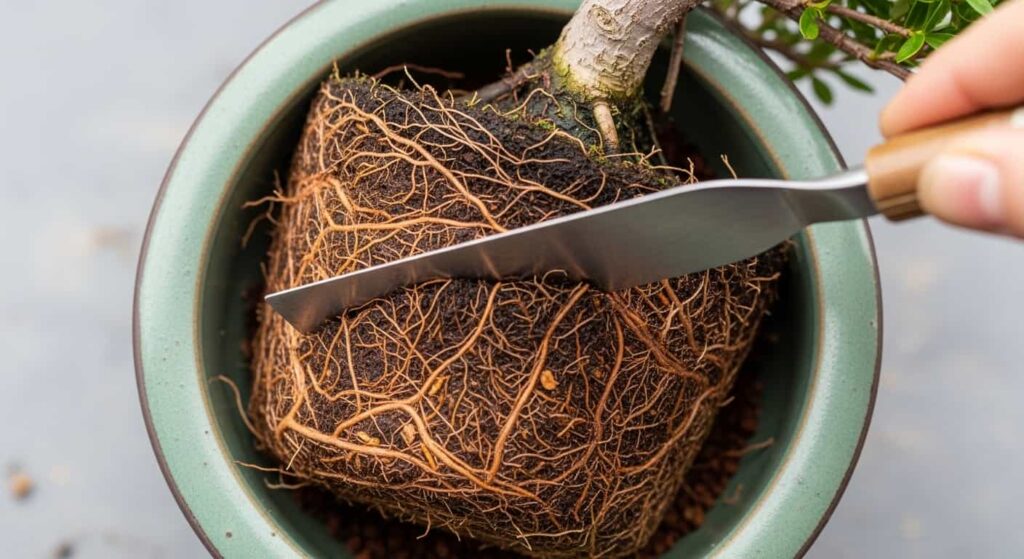
How to use it: slide the flat blade or curved tip between the inner wall of the pot and the root ball, working around the perimeter. You’re separating roots that have stuck to the sides, not prying the whole tree upward in one jerk. Once the mass is loose, lift the tree out and set it on your bench before you start combing.
Why this comes first: forcing the pot off without loosening the edges tears feeder roots along the rim. This step is how you use a root hook before fine root work begins.
Step 2: Loosen compacted soil with a multi-tine rake

How to use it: hold the handle so the tines point slightly downward into the outer layer of the root ball. Comb through the mass in short strokes, working around the ball and from bottom toward the sides—not straight through the heart of the trunk on the first pass. Let the tines carry old soil and loose debris out; repeat until the outer soil is broken up and roots start to separate.
Tine count: 2-tine is a middle ground; 3-tine is the common all-rounder; 4-tine covers larger, denser root pads faster.
What to avoid: dragging multiple tines tight against the base of the trunk on the first pass—snags on fine surface roots are more likely there. Save that zone for a single-tine hook.
Step 3: Precision untangling with a single-tine root hook

How to use it: use the one curved tine like a fine pick: slip it along the length of individual roots to separate crossings, lift away clinging soil, and expose the nebari. Work slowly; you should feel each root through the handle. This is the stage where technique matters most for preservation—small movements, no ripping.
Best for: nebari detail, crossing roots, and small or shohin trees where a rake is clumsy.
What to avoid: trying to clear a large, heavily compacted ball from scratch with only a single tine—you’ll fatigue, then jab harder and tear roots. Do bulk loosening with a multi-tine rake first.
Step 4: Woody or very tough root masses (jin hook)
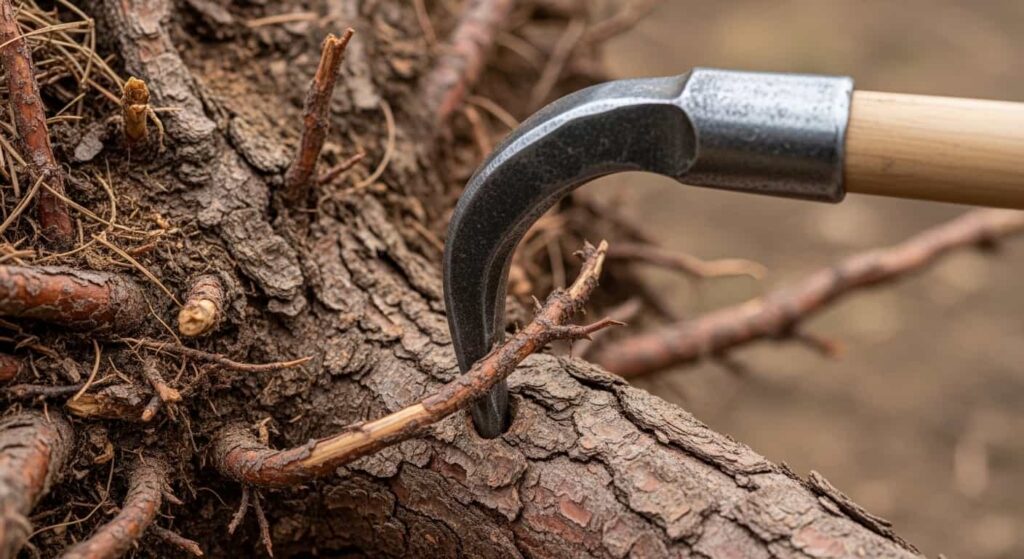
How to use it: apply the stronger, blunter tine where roots are fibrous or matted and a finer hook bends or slips—still combing and separating, not chopping. Some growers use the same tool for jin/shari work; for pure root work, treat it as a heavy-duty comb for stubborn layers.
When: collected material, old trees, or sections where a standard rake won’t bite without flexing.
Step 5: Working soil into the new pot (chopstick—after hook work)
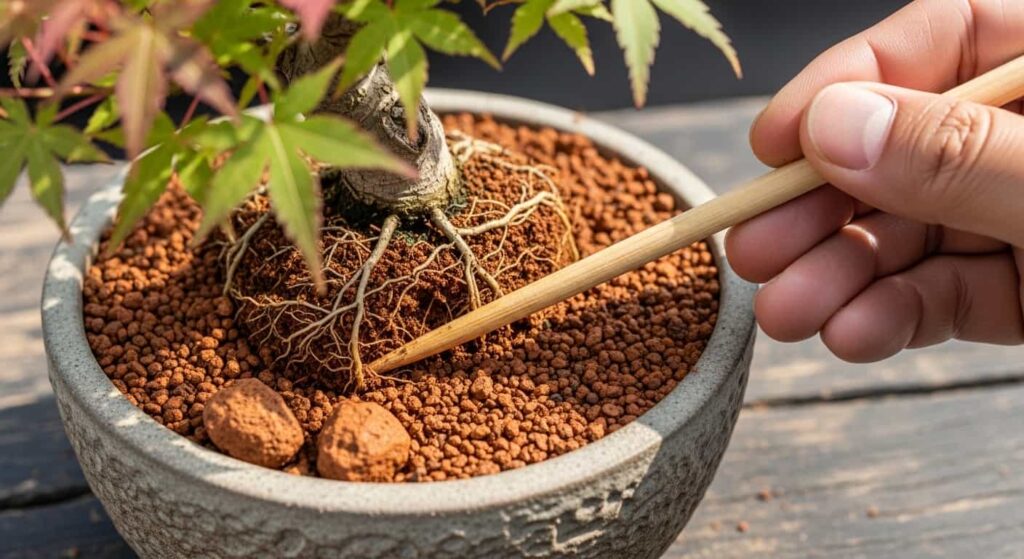
This step isn’t done with a metal root hook. After you’ve used your hook to prepare and position roots, a bamboo chopstick is ideal for back-filling: poking substrate down between roots without snagging or cutting them. For very small trees, a chopstick can also help nudge surface soil during early inspection where any metal hook feels oversized.
The main mistake when learning how to use a bonsai root hook
Using one hook for every phase. The classic error is taking a single-tine hook to a large, compacted root ball and trying to “power through.” That leads to slow progress, harder jabs, and torn roots.
Better approach: match the tool to the phase—spatula to release, multi-tine rake for bulk soil and general combing, single-tine for detail, jin hook only where the mass is truly tough. Same idea as rough sanding before fine sanding.
Quick guide: which hook for which part of the job
| Stage / situation | Tool to reach for |
|---|---|
| Stuck in the pot | Flat spatula / flat hook |
| Outer soil, dense root pad | 2–4 tine rake |
| Nebari, crossings, fine roots | Single-tine hook |
| Woody, matted, collected roots | Jin hook |
| Back-filling soil in new pot | Chopstick |
| Tree size / condition | Practical combo |
|---|---|
| Mame / shohin | Single-tine and/or chopstick |
| Small tree, loose roots | Single-tine |
| Small tree, compact | 2–3 tine rake, then single-tine |
| Medium | 3–4 tine rake + single-tine |
| Large / yamadori | Jin hook + 4-tine rake where needed |
Handles and care (short)
Handle material mainly affects comfort and durability—hardwood and quality synthetics are kinder on long sessions than thin or slippery grips. After each use, rinse tines, scrub dry soil off, dry fully, and oil metal occasionally so rust doesn’t transfer to roots. Store hooks so tines don’t bend.
Frequently asked questions
Can I use a garden fork instead of learning how to use a bonsai root hook?
Not for real refinement. Garden forks are too large and clumsy for fine feeder roots; a bonsai-sized hook keeps the motion small and controlled.
How many hooks do I need?
For most home setups: a 3-tine rake, a single-tine hook, and a chopstick cover almost everything. Add a spatula if you repot often; add a jin hook if you work tough or collected material.
Do expensive hooks change how you use them?
Balance and stiff tines help over long sessions, but mid-range Japanese or German tools are often enough. Avoid the cheapest options where tines bend—the technique fails if the tool flexes wrong.
When should I avoid root work?
During summer heat, late autumn, or when the tree is sick or newly acquired. Early spring, just before buds break, is the usual window for repotting and hook work.
Summary
How to use a bonsai root hook comes down to sequence and pressure: free the ball from the pot, comb out compaction with the right rake, then switch to a single-tine hook for detail. Use a heavier hook only where roots are truly woody; finish filling with a chopstick, not metal.
Start with a 3-tine rake and a single-tine hook and practice the workflow on smaller trees first. Clean, staged root work shows up in nebari clarity and tree vigor for years.