Last Updated on March 16, 2026 by Indoor Plant Nook
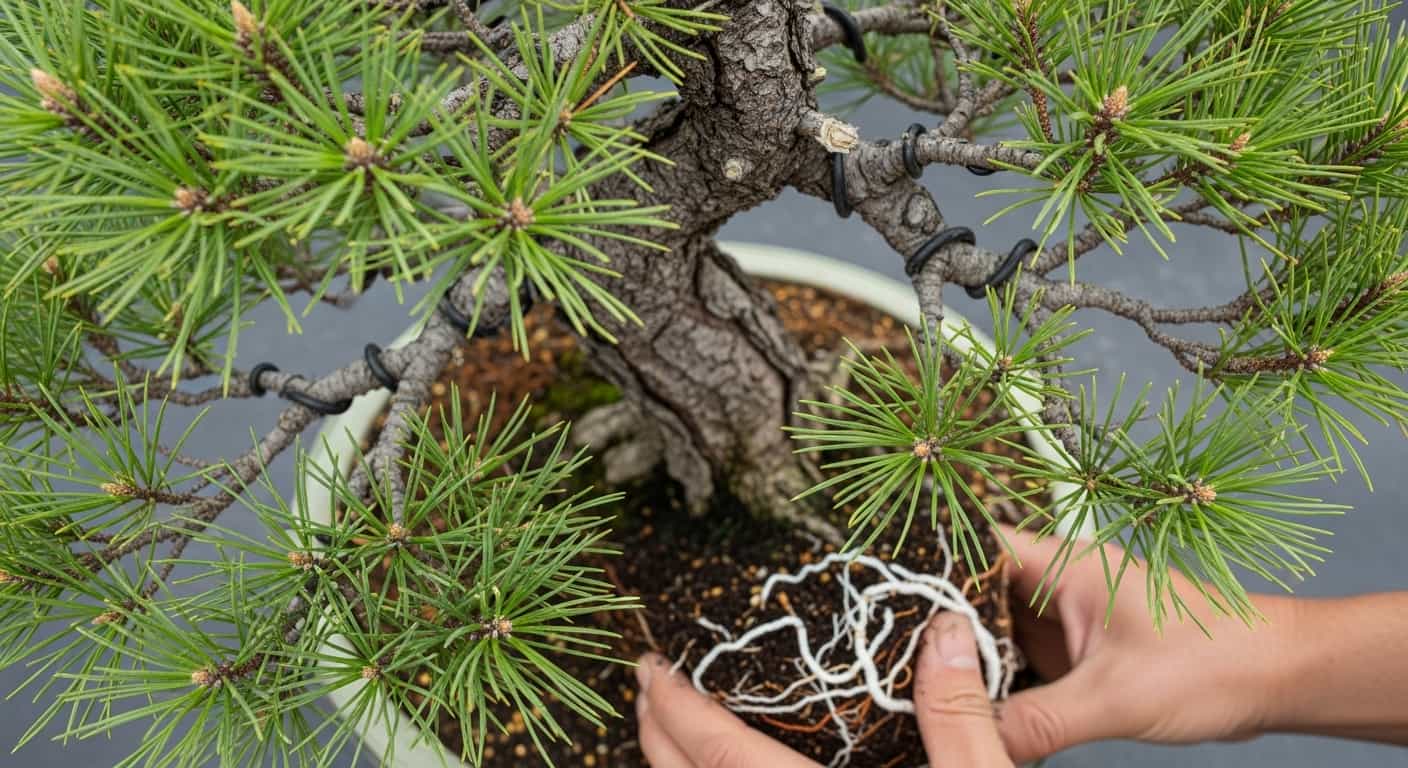
Pine bonsai are among the most rewarding trees to cultivate — but they are also among the most unforgiving when it comes to root disturbance. If you’ve been wondering whether root washing is safe for your pine bonsai, you’re asking exactly the right question before you reach for that hose.
The short answer: Root washing can be safe for pine bonsai, but only under very specific conditions. Done at the wrong time, on the wrong tree, or without understanding pine mycorrhizal biology, it can seriously harm or even kill your tree.
This guide covers everything you need to know — from the science behind pine roots to a step-by-step safe technique, the best timing, risks to avoid, and when you simply should not do it at all.
1. What Is Root Washing in Bonsai?

Root washing is the process of removing all or most of the old soil from a bonsai’s root system — typically using water — before repotting it into fresh substrate. It gives the grower full visibility of the root structure, allows precise root pruning, and ensures the tree is potted in clean, well-draining medium.
For many deciduous species like maples, elms, and junipers, root washing is a fairly standard repotting technique. Pine bonsai, however, operate under a completely different set of biological rules.
2. Why Pines Are Different from Other Bonsai Trees
Pines belong to the genus Pinus and are obligate mycorrhizal trees — meaning they cannot survive long-term without a specific symbiotic fungal relationship. This is the central reason why root washing a pine demands far more caution than it would for most other bonsai species.
Other key differences include:
- Slow recovery rate. Pines are not fast healers. Root damage that a maple might recover from in one growing season can take a pine two or three years — or prove fatal.
- No feeder roots without mycorrhizae. Pine roots don’t absorb water and nutrients efficiently on their own. The fungal network is the actual feeding apparatus.
- Highly sensitive to compacted or waterlogged soil. Pines evolved in lean, well-drained soils and are prone to root rot if kept in moisture-retentive old soil.
3. The Role of Mycorrhizae in Pine Health
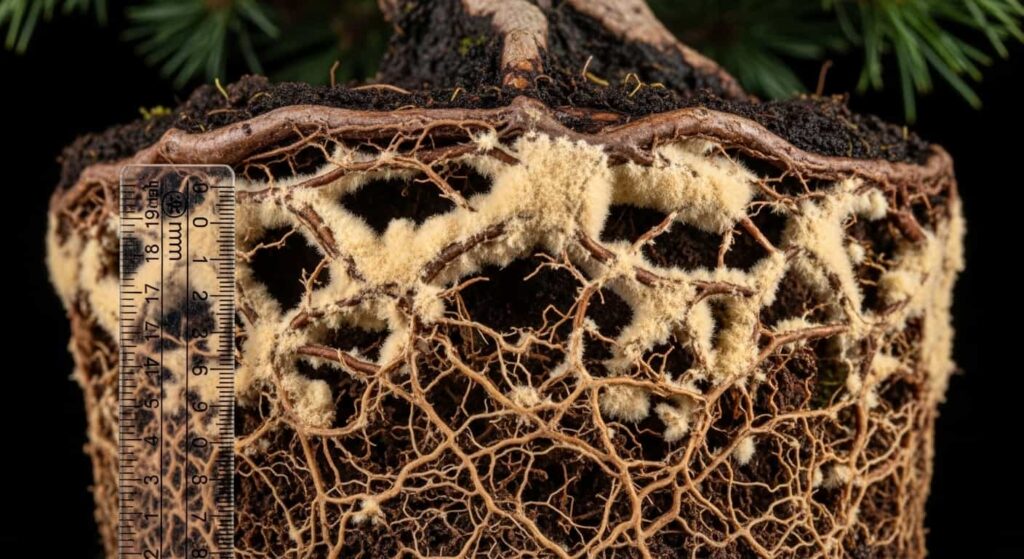
Mycorrhizal fungi colonize pine roots and form structures called mycorrhizal tips — short, clustered, often white or cream-colored root endings. Under a magnifying lens, healthy pine roots look almost fuzzy with these fungal associations.
These fungi dramatically extend the effective surface area of the root system, improve mineral uptake (especially phosphorus), and help the tree tolerate drought and pathogens.
Why this matters for root washing:
When you wash the roots of a pine, you risk:
- Dislodging or destroying mycorrhizal tips
- Washing away the spore-rich soil in which the fungi live
- Severing the hyphal threads that connect the fungal network
Losing a significant portion of mycorrhizal activity forces the tree to survive on its own root capacity alone — a serious stressor that can lead to rapid decline.
Key insight: The goal when root washing a pine is not to achieve bare, clean roots. It’s to remove enough old soil to repot successfully while preserving as much of the fungal community as possible.
4. Is Root Washing Safe for Pine Bonsai?
Yes — with important conditions.
Root washing is safest when:
| Condition | Details |
|---|---|
| The tree is healthy and vigorous | Strong, well-ramified canopy, active growth |
| Timing is correct | Late winter / early spring, just before buds swell |
| Mycorrhizal soil is partially retained | Not all old soil is removed |
| The tree is in its repotting cycle | Roots are visibly pot-bound, or the soil has broken down |
| Aftercare is dialed in | Shade, humidity, careful watering post-repot |
Root washing is risky or contraindicated when:
- The tree has shown signs of weakness or dieback in the past one to two years
- It’s midsummer, or the tree is in full growth
- The pine was recently collected from the wild (yamadori)
- The tree has been recently repotted (within the last two to four years)
- You cannot provide a controlled recovery environment
5. When Is the Right Time to Root Wash a Pine?
Timing is arguably the most critical variable in pine bonsai root washing.
The Best Window: Late Winter to Early Spring
The ideal time is just as the buds begin to swell, but before they fully open — typically late February through March in temperate climates (adjust for your hardiness zone). At this stage:
- The tree is exiting dormancy, and its energy is rising
- New root growth is about to begin, meaning recovery starts quickly
- The tree hasn’t yet invested significant energy into canopy growth
What to Avoid
- Late spring or summer: The tree is in peak growth, and any root disruption diverts energy away from canopy and root development simultaneously.
- Fall: Root wounds are slow to callus before winter arrives.
- Deep winter: The tree lacks the metabolic activity to recover from root disturbance.
6. How to Root Wash a Pine Bonsai: Step-by-Step

What You’ll Need
- Bucket of room-temperature water (never cold water from the tap)
- Chopstick or root hook
- Sharp, sterile bonsai scissors
- Fresh, well-draining substrate (akadama, pumice, and lava rock blend is standard)
- New or cleaned bonsai pot
- Shade cloth for aftercare
Step-by-Step Process
Step 1 — Water the tree thoroughly the day before. A well-hydrated tree handles root work with less shock.
Step 2 — Remove the tree from its pot. Work carefully and tilt the root ball out rather than pulling the trunk.
Step 3 — Remove the outer third of the soil. Use a chopstick or root hook to loosen the outer soil mass. Do not aim for completely bare roots. Leave the inner soil core — especially near the trunk — largely intact to preserve as much mycorrhizal activity as possible.
Step 4 — Rinse gently, not aggressively. If you need to wash roots for inspection, use a gentle stream of room-temperature water. Avoid high-pressure hoses. Work from the outside edges inward and stop well before the core.
Step 5 — Inspect root health. Look for:
- Healthy white or cream mycorrhizal tips (good — preserve these)
- Dark, mushy, or foul-smelling roots (rot — remove cleanly with sterile scissors)
- Circling or crossing roots that need correction
Step 6 — Prune dead or problematic roots only. Resist the temptation to prune aggressively. Remove only what is dead, diseased, or structurally problematic.
Step 7 — Repot promptly. Do not leave roots exposed to air for more than a few minutes. Place the tree in fresh substrate and secure it with wire to prevent movement.
Step 8 — Water in thoroughly after repotting to settle the soil and eliminate air pockets.
7. How Much Root Can You Safely Remove?
As a general rule, remove no more than one-third of the root mass at any single repotting session for a healthy pine. For weaker or older trees, limit removal to one-quarter or less.
This conservative approach ensures:
- Enough mycorrhizal network remains intact
- Sufficient root mass to support the canopy during recovery
- The tree doesn’t experience hydraulic failure (inability to move water from roots to leaves)
If your pine is severely pot-bound and needs significant root reduction, consider spreading the work over two repotting cycles rather than doing it all at once.
8. Signs Your Pine Is Stressed After Root Washing
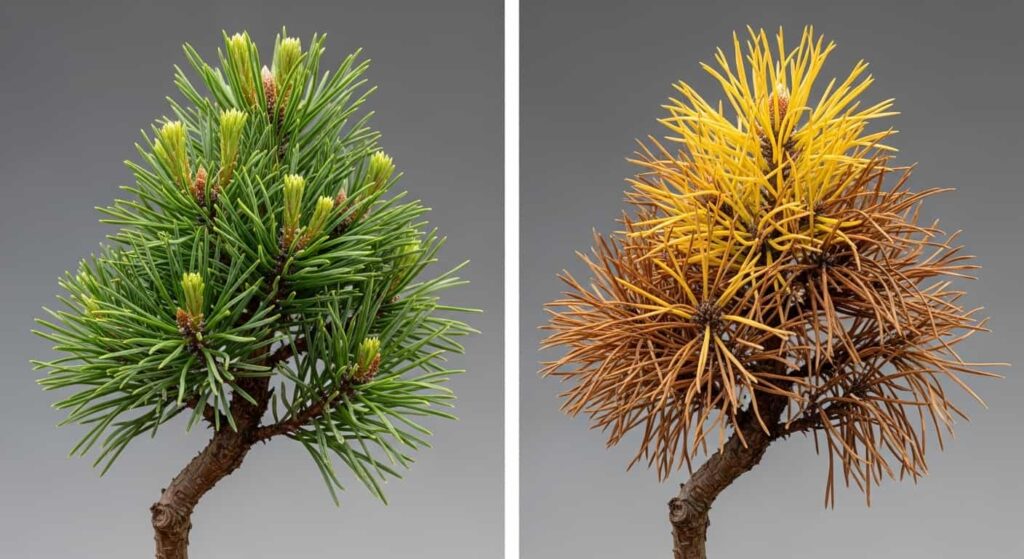
Monitor your pine closely in the weeks following repotting. Warning signs include:
- Needle yellowing or browning from the tips inward
- Buds failing to open or opening and then staling
- Drooping or flagging shoots despite adequate watering
- Premature needle drop outside of the normal autumn cycle
Mild stress (slight needle tip browning on a small percentage of needles) is normal and usually resolves on its own. Widespread decline is a red flag requiring immediate evaluation of watering, drainage, and placement.
9. Aftercare: How to Help Your Pine Recover
Proper aftercare is what separates a successful root washing from a disaster.
Placement
Keep the repotted pine in dappled shade for four to six weeks after repotting. Direct sun stresses a tree that is simultaneously recovering its root system. Gradually reintroduce it to full sun.
Watering
Water carefully — the fresh substrate can dry faster than old, compacted soil. Check moisture daily by inserting a wooden chopstick into the soil. Water when the top half-inch is dry, but never let the soil become waterlogged.
Fertilizing
Do not fertilize for the first four to six weeks. The recovering root system cannot efficiently process fertilizer, and excess nutrients can burn tender new roots. Once you see new bud movement confirming the tree is active, begin light fertilization.
Wind
Protect the tree from strong winds. A freshly repotted pine with a reduced root system is vulnerable to desiccation from wind exposure.
Avoid Further Stress
Do not perform any canopy work — pruning, wiring, or needle pulling — in the same season as root washing. Give the tree the entire growing season to recover.
10. Common Mistakes to Avoid
Washing all the soil off bare. Completely bare roots may look clean and satisfying, but for pine bonsai, it’s potentially catastrophic. Always leave the inner core of mycorrhizal-rich soil.
Use cold tap water. Cold water can shock roots and inhibit mycorrhizal activity. Use water at or near room temperature.
Repotting in late spring or summer. Even experienced growers lose pines by ignoring the timing window.
Over-pruning roots. More is not better. Pine roots do not regenerate as readily as deciduous species.
Skipping aftercare. Placing a freshly root-washed pine in full sun and going back to normal fertilizing immediately is a common recipe for tree loss.
Washing a recently collected pine. Yamadori (field-collected) pines are already under severe stress. Their mycorrhizal networks are partially disrupted by collection. Wait at least two to three years of stable recovery in a container before any root washing.
11. Alternatives to Full Root Washing

If you’re not confident about root washing, or your pine doesn’t meet the criteria for a safe procedure, consider these gentler alternatives:
- Partial soil removal: Remove the outer 20–30% of soil using a chopstick during repotting without washing. This refreshes the substrate while preserving the mycorrhizal core.
- Soil top-dressing: Replace only the top layer of soil without disturbing the root ball at all.
- Extended repotting cycle: Instead of every two years, allow your pine three to four years between repottings to give it maximum time to establish.
- Topdressing with mycorrhizal inoculant: If you must disturb the root zone, adding a commercial mycorrhizal inoculant to the fresh substrate can help re-establish fungal activity faster.
12. FAQs
Can I root wash a Japanese black pine?
Yes. Japanese black pine (Pinus thunbergii) is one of the more adaptable pine species and tolerates repotting better than many others. Still, follow all the precautions above and respect the timing window.
Can I root wash a collected (yamadori) pine?
Not for the first two to three years after collection. Let the tree re-establish itself fully before any aggressive root work.
How often should I repot a pine bonsai?
Most pine bonsai benefit from repotting every three to five years, depending on pot size and root development. Younger, faster-growing trees may need it every two to three years.
Do I need to add mycorrhizal inoculant when repotting?
It’s not strictly necessary if you’re leaving the core soil intact, but it can be a useful insurance policy, especially after any significant root disturbance.
What substrate should I repot my pine into?
A mix of akadama (40%), pumice (40%), and lava rock (20%) is widely used and provides the excellent drainage pines require. Avoid mixes with high organic content, which retain too much moisture.
My pine’s needles are turning yellow after repotting — is it dying?
Not necessarily. Mild needle yellowing after repotting is a common stress response. Monitor for several weeks. If new buds are still opening and growth continues, the tree is likely recovering. If decline accelerates or spreads rapidly to whole branches, investigate drainage, watering, and root condition immediately.
Final Thoughts
Root washing pine bonsai is not inherently dangerous — but it demands respect for the tree’s biology, strict attention to timing, and a light touch with the water. The biggest mistake growers make is treating a pine the same as a juniper or maple during repotting. It isn’t.
Preserve the mycorrhizal community, stay within the late-winter repotting window, err on the side of removing less rather than more, and invest in proper aftercare. Do those things, and root washing can be a powerful tool for improving the long-term health and development of your pine bonsai.
When in doubt, go slower, do less, and give the tree time. Pines reward patience.