
Last Updated on March 15, 2026 by Indoor Plant Nook
When you prune a bonsai, the conversation immediately shifts to the roots. Every cut on the canopy triggers a stress response underground — and the soil sitting around those roots either accelerates recovery or quietly holds the tree back for an entire growing season.
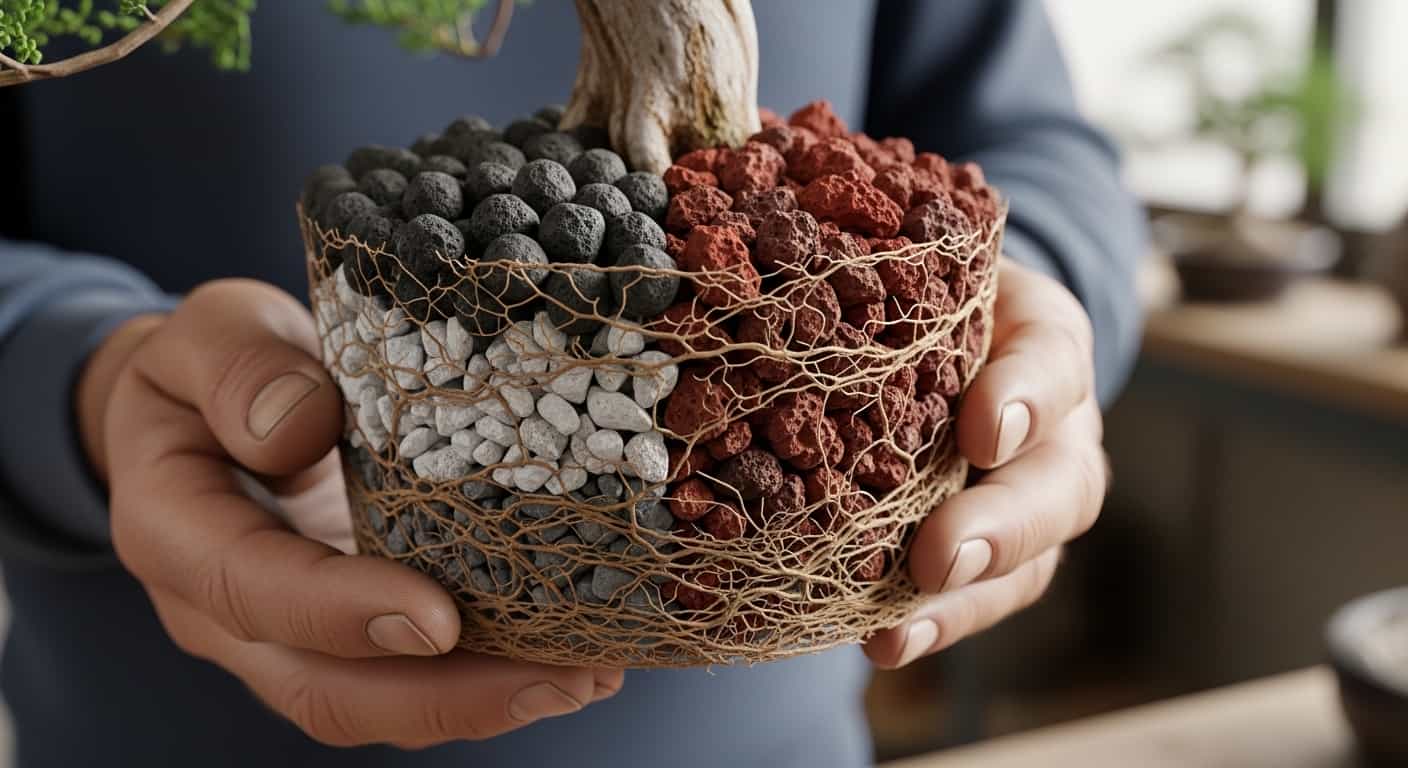
This is not a product comparison. This is a guide to understanding what your bonsai’s root system actually needs after pruning stress — and how the three most popular inorganic substrates (akadama, pumice, and lava rock) each play a completely different biological role during that recovery window.
Why Post-Pruning Soil Choice Is Different From Regular Repotting
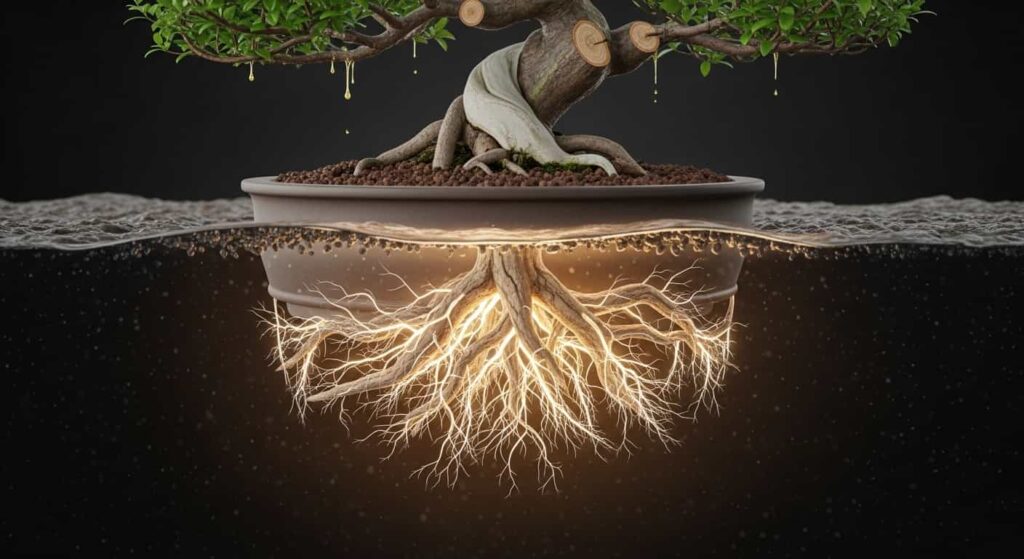
Most bonsai guides treat substrate selection as a one-size-fits-all topic. But the period immediately after pruning is a physiologically distinct phase.
When branches are removed, the tree reallocates photosynate toward wound callusing and root-to-shoot ratio rebalancing. During this window:
- Water uptake slows because fewer leaves are transpiring
- Root oxygen demand increases as new feeder roots push through the media
- Fungal activity spikes around any root wounds from simultaneous root pruning
- Nutrient absorption is suppressed until new fine roots establish
This means your soil needs to handle reduced water throughput without becoming waterlogged, maintain high oxygen levels at the root zone, and support microbial balance — all at the same time.
That is where the three-substrate conversation becomes genuinely important.
Akadama: The Cation Exchange Powerhouse With a Timing Problem
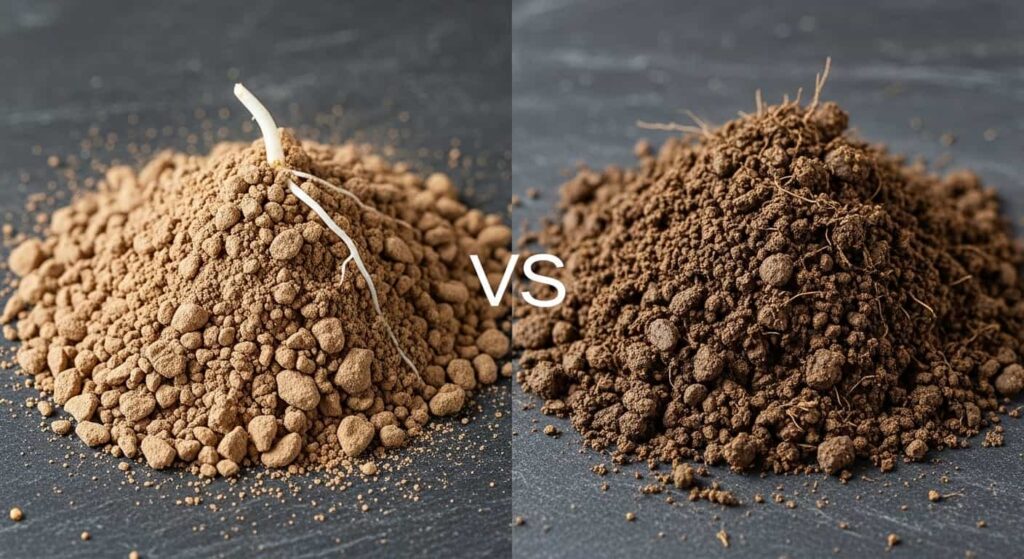
Akadama is calcined clay mined in Japan, and it has a unique property that no other substrate can replicate at scale: cation exchange capacity (CEC). It holds and slowly releases mineral nutrients — calcium, magnesium, potassium — directly to root hair contact points.
What Akadama Does Well After Pruning
- Creates a soft, slightly compressible texture that new feeder roots penetrate easily
- Holds moisture near roots without pooling — critical when transpiration is reduced post-pruning
- Gradually breaks down over 2–3 years, becoming increasingly root-friendly in texture.
The Post-Pruning Problem With Akadama Alone
Akadama’s weakness is its breakdown rate. Fresh akadama has excellent porosity, but used akadama compacts under wet/dry cycling. If you’re repotting into a substrate with degraded akadama right after heavy pruning, the drainage profile will disappoint exactly when the tree needs oxygen most.
The rule: Use akadama at 40–50% of a mix, never 100%, and always assess whether your existing akadama still has particle integrity before a post-pruning repot.
Akadama Particle Size After Pruning
For recovery mixes, use 2–3mm akadama rather than larger grades. Smaller particles mean more surface area for root contact and faster nutrient exchange during the critical first flush of new growth.
Pumice: The Unsung Hero of Root Zone Oxygen
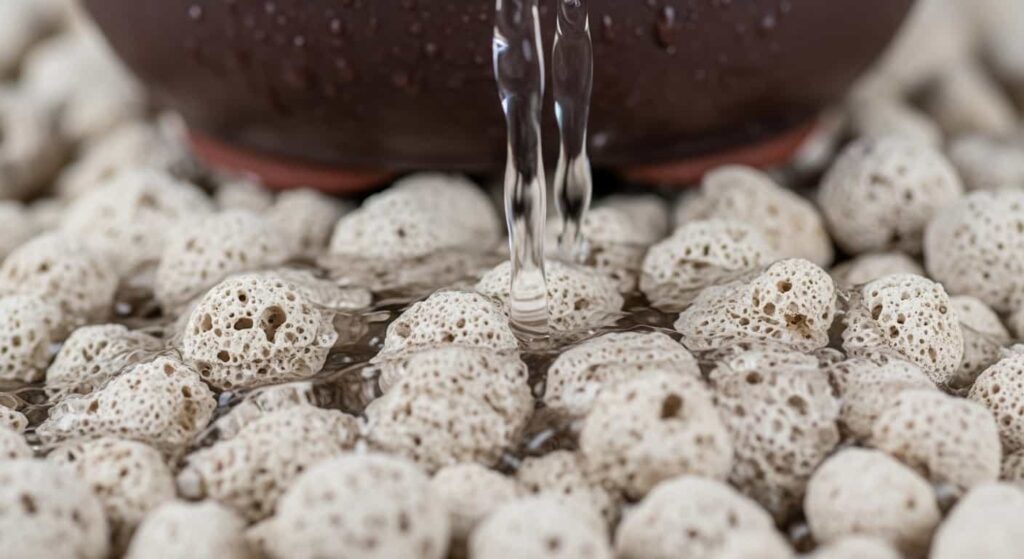
Pumice is volcanic glass — extremely lightweight, extremely porous, and biologically neutral. It does almost nothing except hold space open and hold a thin film of water on its silica surface.
That sounds underwhelming. It is not.
What Pumice Actually Does in a Post-Pruning Mix
After pruning, your bonsai’s root system is navigating a paradox: it needs moisture for cellular function, but excess moisture promotes the exact pathogenic fungi (primarily Fusarium and Phytophthora species) that attack stressed root tips.
Pumice resolves this paradox structurally. Its rigid, non-compressing particles create macro-pores — air channels that persist even when the mix is fully watered. These channels:
- Allow excess water to drain in seconds
- Pull oxygenated air back into the root zone as water drains (the “suction” effect)
- Create physical separation between roots, reducing the spread of pathogens
Unlike akadama, pumice does not break down over time. A pumice particle you plant today will look identical in 10 years. This makes it the structural backbone of any long-term mix.
How Much Pumice in a Post-Pruning Mix?
For deciduous trees post-pruning: 25–35% pumice is the standard range. For conifers or trees with known drainage sensitivity: push to 40–45%. For trees in humid climates or frequently overwatered situations: 50% pumice is not excessive.
The practical test: water the tree and watch the drainage holes. Water should begin flowing within 2–3 seconds of watering. If it takes longer, increase the pumice proportion.
Lava Rock: The Microbial Colony Manager
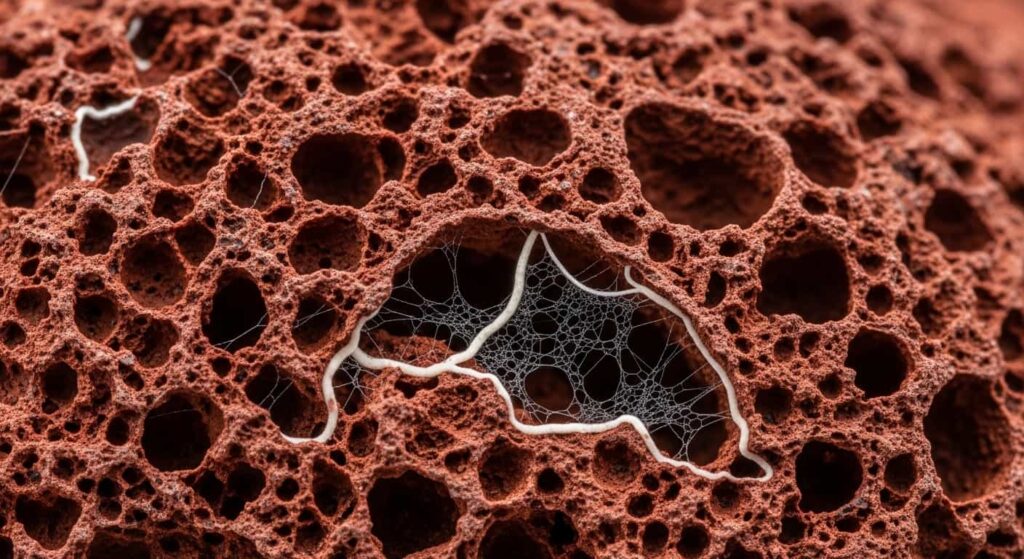
Lava rock (scoria) is the most misunderstood of the three substrates. Many growers use it purely as a drainage aid — a cheaper pumice substitute. This misses its most important function.
The Microbial Surface That Pumice Lacks
Under magnification, lava rock’s surface is deeply textured with micro-cavities. These cavities are the preferred colonization site for mycorrhizal fungi and beneficial bacteria — the organisms responsible for extending the tree’s effective root zone and converting organic matter into plant-available nutrients.
After pruning, mycorrhizal networks around damaged roots need to reestablish. Lava rock provides the physical architecture for this recolonization to happen faster than in pumice-only or akadama-only substrates.
What Lava Rock Does Not Do Well
- It does not hold moisture — lava rock dries out faster than akadama or pumice.
- It does not contribute to CEC — there is minimal nutrient exchange from lava rock itself.
- Irregular particle shapes can occasionally impede very fine root growth in the 0.5–1mm range.
Lava Rock Particle Size Matters More Than You Think
Post-pruning mixes benefit from 3–6mm lava rock — large enough to maintain macro-porosity but small enough to allow normal root navigation. Particles above 10mm create air pockets too large for root systems to bridge efficiently.
Building the Post-Pruning Mix: The Evidence-Based Ratios
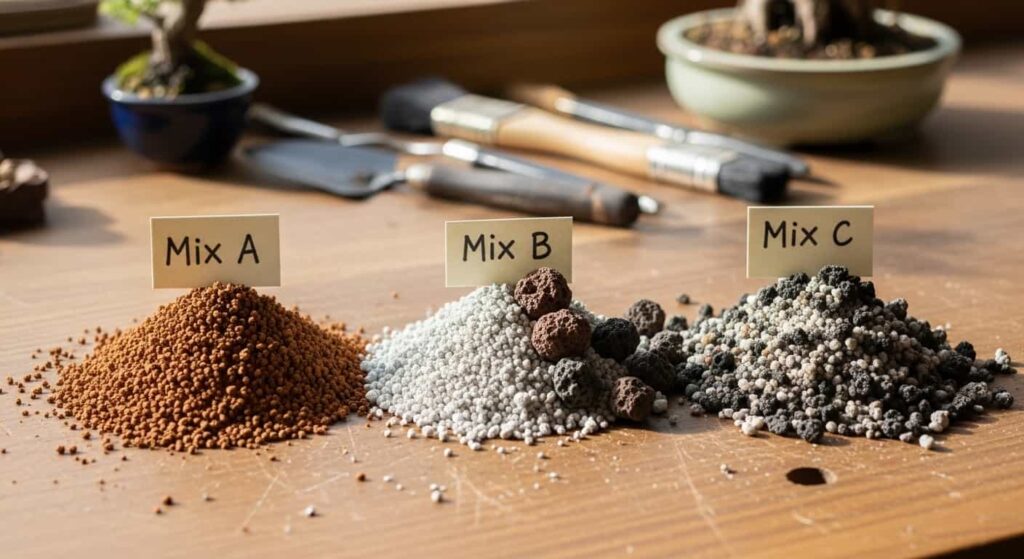
There is no universal perfect ratio. There is a framework.
The Variables That Change the Formula
1. Species Junipers and pines tolerate lower moisture retention — lean toward pumice and lava rock. Maples and elms need slightly more moisture during recovery — lean toward akadama.
2. Climate Humid climates (Southeast Asia, Southeast USA, coastal regions): reduce akadama, increase pumice. Arid climates (Mediterranean, inland continental): increase akadama, reduce pumice.
3. Pot size and depth. Shallow pots drain faster — slightly higher akadama content compensates. Deep pots retain more moisture — increase pumice and lava rock proportion.
4. Pruning severity Light canopy pruning: standard mix applies. Heavy defoliation or combined root + canopy pruning: increase pumice 10–15% beyond your normal ratio to prevent stress compounding from poor oxygen access.
Three Tested Post-Pruning Ratios
Mix A — Deciduous Trees, Temperate Climate
| Substrate | Proportion |
|---|---|
| Akadama | 50% |
| Pumice | 30% |
| Lava Rock | 20% |
Best for: Japanese maple, trident maple, hornbeam, zelkova
Mix B — Conifers and Junipers, Any Climate
| Substrate | Proportion |
|---|---|
| Akadama | 33% |
| Pumice | 40% |
| Lava Rock | 27% |
Best for: Shimpaku juniper, Japanese black pine, white pine, spruce
Mix C — High-Humidity or Heavy-Watering Environments
| Substrate | Proportion |
|---|---|
| Akadama | 25% |
| Pumice | 50% |
| Lava Rock | 25% |
Best for: any species where drainage is consistently a problem
The One Thing Most Guides Get Wrong About This Topic

Most substrate comparisons focus on what each material looks like in a bag and what the package says about drainage ratings.
They skip the biological layer.
Bonsai soil is not a passive medium. After pruning, your substrate is an active ecosystem — it is hosting fungal networks, bacterial colonies, and nematode populations that directly influence whether your tree’s recovery takes 3 weeks or 3 months.
The practical implication: when you build a post-pruning mix, consider inoculating it with a mycorrhizal powder pressed against the root ball before covering. Lava rock’s surface structure will retain and propagate that inoculant. Pumice will not. Akadama will partially support it.
This single step — invisible and rarely discussed — can reduce post-pruning stress visibly within one growing cycle.
Substrate Breakdown: Quick Reference
| Property | Akadama | Pumice | Lava Rock |
|---|---|---|---|
| Water retention | High | Low–Medium | Very Low |
| Drainage speed | Medium | Fast | Fast |
| Oxygen retention | Medium | High | High |
| CEC (nutrient holding) | High | Very Low | Very Low |
| Microbial support | Medium | Low | Very High |
| Longevity in mix | 2–4 years | 10+ years | 10+ years |
| Particle durability | Moderate | High | High |
| Cost | Moderate–High | Moderate | Low–Moderate |
Frequently Asked Questions
Can I use only pumice after pruning?
You can, but you will likely need to water more frequently as the tree recovers (pumice dries quickly), and you will miss the cation exchange benefit akadama provides during the new root flush. A pure pumice mix is a reasonable emergency option if you have nothing else — not an ideal long-term substrate post-pruning.
How soon after pruning should I repot into a fresh mix?
Ideally, pruning and repotting happen simultaneously in early spring before bud break. If you have already pruned but not repotted, repot during the next appropriate seasonal window rather than immediately — doubling stress rarely improves outcomes.
Does lava rock color matter?
No. Red, black, and grey lava rock have the same functional porosity. Color variation reflects mineral composition, not drainage or microbial support capacity.
Is akadama necessary, or can I substitute it with other calcined clays?
Turface, Haydite, and similar fired clays offer partial substitution, but their CEC and particle consistency vary significantly by brand and production batch. Japanese akadama remains the most consistent calcined clay for bonsai use — substitutes are workable but require individual testing.
How do I know when akadama needs replacing?
Press a dry particle between your thumb and forefinger. If it crumbles easily, the akadama has lost structural integrity and will compact your root zone. Replace at the next repotting opportunity.
Final Takeaway
After pruning, your bonsai is in a controlled crisis state — and the substrate around its roots is either a recovery tool or a hidden stressor.
Akadama feeds the roots. Pumice oxygenates them. Lava rock supports the invisible microbial community that neither of the other two can do.
Use all three together in proportions calibrated to your species and climate, and the post-pruning recovery period becomes the fastest, most efficient phase of your tree’s development rather than the most anxious one.