

Last Updated on March 16, 2026 by Indoor Plant Nook
Root rot is one of the most common — and most heartbreaking — problems ficus bonsai owners face. By the time you notice something is wrong above the soil, the damage below may already be severe. The good news is that with early detection and the right recovery steps, many ficus bonsai can be saved.
This guide walks you through every stage: understanding what causes root rot, recognizing the warning signs, confirming the diagnosis, and executing a full recovery plan that gives your tree its best chance at survival.
What Is Root Rot in Ficus Bonsai?

Root rot is a condition in which a plant’s roots begin to decay, typically due to prolonged exposure to excess moisture. In bonsai, where trees live in small containers with limited soil volume, the problem can escalate rapidly.
When roots sit in waterlogged soil, oxygen is cut off. Without oxygen, healthy roots cannot function — they begin to die and decompose. This dead tissue then becomes a breeding ground for fungal pathogens, most commonly Phytophthora and Pythium species, as well as Fusarium and Rhizoctonia. These fungi accelerate the rot, spreading it to previously healthy roots.
Ficus bonsai are particularly vulnerable because:
- They are often kept indoors where air circulation is limited
- Owners frequently overwater them out of care
- Their pots are often decorative rather than functional, with poor drainage
- They are tropical trees that signal stress subtly and slowly
Common Causes of Root Rot
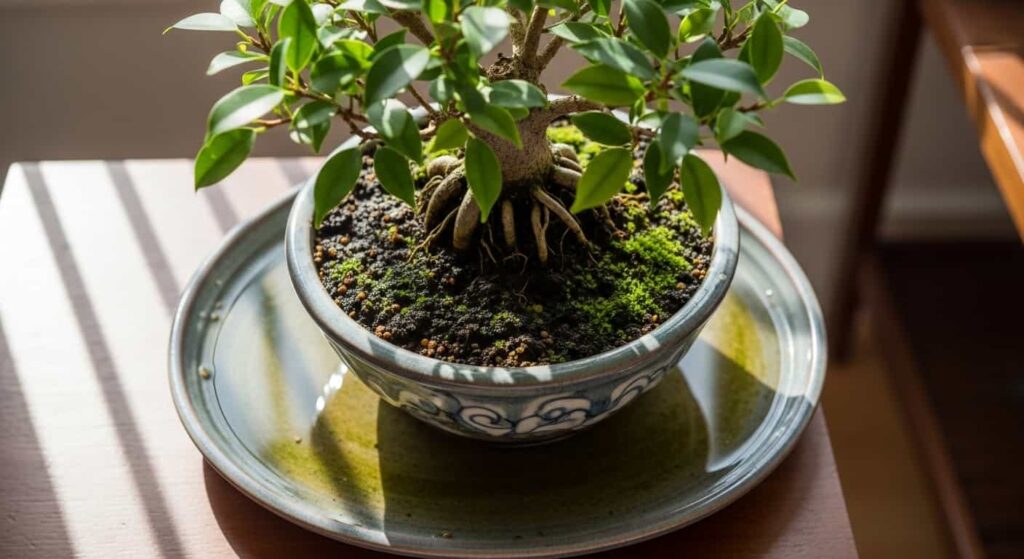
Understanding the root cause (no pun intended) is essential before treatment. Without addressing the underlying problem, the rot will return even after recovery.
1. Overwatering
This is the number one cause. Many bonsai owners water on a fixed schedule rather than checking soil moisture. Ficus roots need to partially dry out between waterings. Constantly wet soil creates the anaerobic (oxygen-free) conditions that fungi thrive in.
2. Poor Drainage
A bonsai pot without adequate drainage holes, or soil that compacts and retains water, will hold moisture far too long. Standard garden soil or dense potting mixes are particularly problematic for bonsai.
3. Wrong Soil Mix
Bonsai require a well-draining, granular substrate. Organic-heavy soils that retain moisture — like regular potting compost — are unsuitable. They break down over time, compacting and losing their drainage capacity.
4. Low Light and Poor Air Circulation
When a ficus bonsai is placed in a dark corner with no airflow, the soil stays wet longer because evaporation is minimal. This alone can tip a marginally overwatered tree into root rot.
5. Temperature Stress
Cold temperatures — especially cold drafts or sitting on a cold windowsill — slow root metabolism, making roots less able to process moisture efficiently. This increases vulnerability.
6. Pots Without Drainage Holes
Decorative pots used without a nursery pot liner trap standing water at the bottom, creating a reservoir of stagnant moisture directly beneath the root zone.
Signs and Symptoms of Root Rot
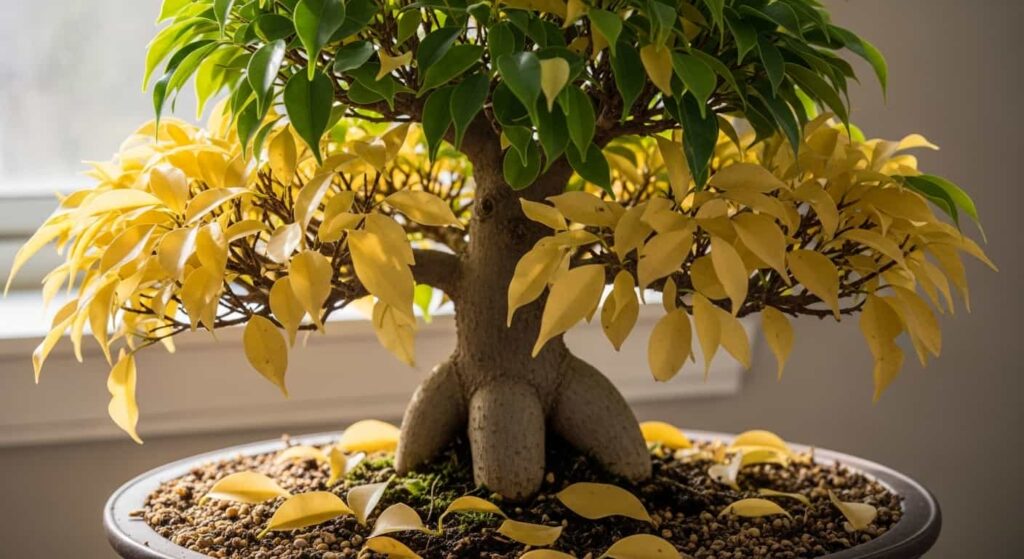
Root rot starts underground, which makes early detection difficult. Most owners only notice it when symptoms become visible above the soil line — at which point the damage is often moderate to severe. Knowing what to look for at each stage dramatically improves recovery outcomes.
Early Warning Signs

- Yellowing leaves — especially lower leaves turning yellow and dropping, even without a change in care
- Leaf drop without apparent cause — ficus are sensitive to change, but sudden, unexplained leaf loss is a warning signal
- Wilting despite moist soil — paradoxically, a ficus may wilt even though the soil is wet, because rotten roots can no longer transport water
- Slowed or stopped growth — during the growing season, a tree that suddenly stops putting out new growth may be struggling below the surface
- Soil that stays wet for too long — if soil is still saturated 7–10 days after watering, drainage is inadequate
Intermediate Signs
- Soft or mushy stems near the base — as rot spreads from roots into the lower trunk, the bark and wood may feel soft or spongy
- Dark, discolored bark at the base — healthy ficus bark is firm and grey-brown; blackened or waterlogged-looking bark near the soil line is alarming
- Foul smell from the soil — decaying roots produce a distinct sulphurous or rotten odor
- Persistent leaf loss — not just a leaf here and there, but ongoing, accelerating defoliation
Advanced Signs
- Branch dieback — tips and entire branches dying back from the extremities inward
- Trunk becoming hollow or soft — indicating the rot has moved well into the vascular system
- Total collapse — in severe cases, the tree may suddenly drop all leaves and appear dead
Pro tip: If your ficus is showing any early warning signs, don’t wait. Unpot the tree immediately to inspect the roots directly. Visual and tactile root inspection is the only reliable diagnosis.
How to Diagnose Root Rot: Step-by-Step

Before treating, you need to confirm the diagnosis. Follow these steps.
Step 1: Water Test
Stop watering and wait 48–72 hours. If the soil is still soaking wet at that point, drainage is severely compromised. This is a strong indicator of a root-rot-prone environment.
Step 2: Unpot the Tree
Carefully remove the ficus from its pot. Gently shake or brush away loose soil. Try not to tear roots unnecessarily.
Step 3: Inspect the Roots
Healthy ficus roots are white to light tan, firm, and flexible. They should not break easily or smell.
Look for:
- Black or brown roots — discoloration is the primary visual indicator of rot
- Mushy texture — healthy roots are firm; rotten roots are soft and will fall apart when touched
- Foul odor — a strong, unpleasant smell confirms fungal decomposition
- Hollow or slimy roots — a sure sign of advanced decay
Step 4: Assess the Damage
Rate the severity:
| Severity | Root Condition | Prognosis |
|---|---|---|
| Mild | Less than 25% of roots affected | Good recovery likely |
| Moderate | 25–50% of roots affected | Recovery possible with prompt treatment |
| Severe | 50–75% of roots affected | Recovery uncertain; aggressive action needed |
| Critical | Over 75% of roots affected | Poor prognosis; propagation may be the only option |
How to Treat and Recover a Ficus Bonsai from Root Rot
Recovery requires removing all diseased tissue, sterilizing tools and soil, and repotting into a clean, well-draining environment. Work quickly — exposed roots dry out fast.
What You’ll Need
- Sharp, sterilized pruning shears or scissors
- Rubbing alcohol or diluted bleach (for sterilizing tools)
- Hydrogen peroxide (3% solution) or a fungicide such as copper fungicide or Mancozeb
- Fresh bonsai soil mix (see recommended mix below)
- A clean pot with drainage holes
- Clean water
- Rooting hormone (optional, for very damaged trees)
Step 1: Prepare Your Workspace

Sterilize all tools with rubbing alcohol before you begin. Lay out newspaper or a tray to work on. Have fresh bonsai soil ready to go — you want to repot quickly once the roots are trimmed.
Step 2: Remove All Dead and Rotten Roots
Using your sterilized scissors or shears, cut away every root that is:
- Black or dark brown
- Soft or mushy to the touch
- Hollow or slimy
- Emitting a foul odor
Cut back to clean, white, firm tissue. If the rot extends deep into a root, follow it all the way and remove the entire root rather than leaving infected tissue behind. Re-sterilize your tool between cuts to avoid spreading fungal spores.
Step 3: Treat the Remaining Roots

Once all diseased roots are removed, treat the healthy remaining roots with one of the following:
Option A — Hydrogen Peroxide Soak: Dilute 3% hydrogen peroxide to a 1-part H₂O₂ / 3-parts water solution. Submerge the root ball for 10–15 minutes. This kills fungal spores and oxygenates the root zone. Allow to air dry briefly before repotting.
Option B — Fungicide Treatment: Apply a copper-based fungicide or Mancozeb to the root zone according to label instructions. This is particularly useful for moderate to severe cases where fungal infection has visibly spread.
Option C — Cinnamon Powder: A natural antifungal, finely ground cinnamon can be dusted over cut root ends as a mild protective treatment. Best for mild cases.
Step 4: Prune the Canopy to Match Root Loss
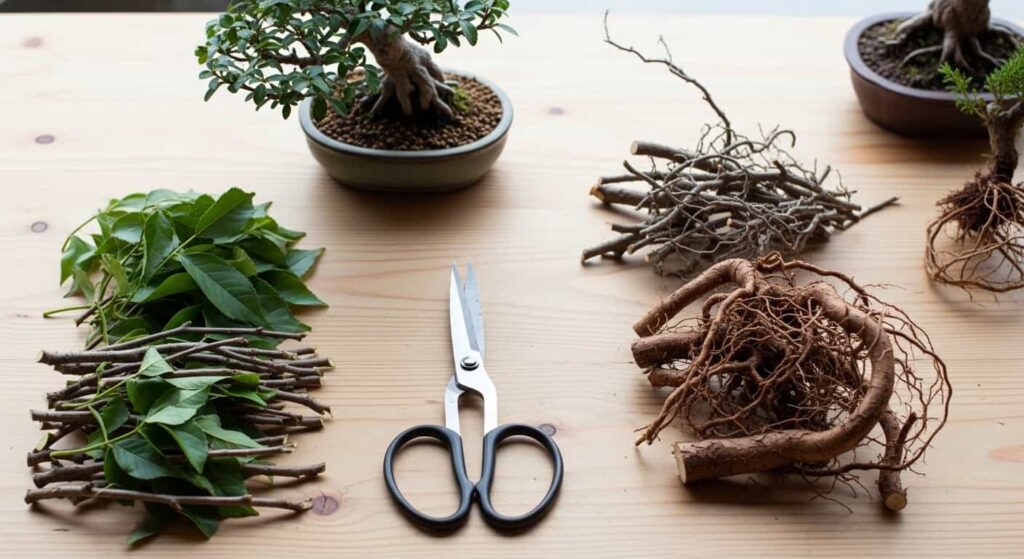
This is a critical step that many beginners skip. Roots and canopy must be in balance. If you removed 40% of the root system, remove approximately 40% of the foliage as well.
Reducing the canopy:
- Decreases the water demand the roots must meet
- Reduces stress on the recovering tree
- Allows energy to be directed toward root regeneration rather than leaf maintenance
Use clean, sterilized shears. Make cuts just above a node or branch junction. Remove interior congested branches first, then trim back outer growth as needed.
Step 5: Repot in Fresh, Well-Draining Soil
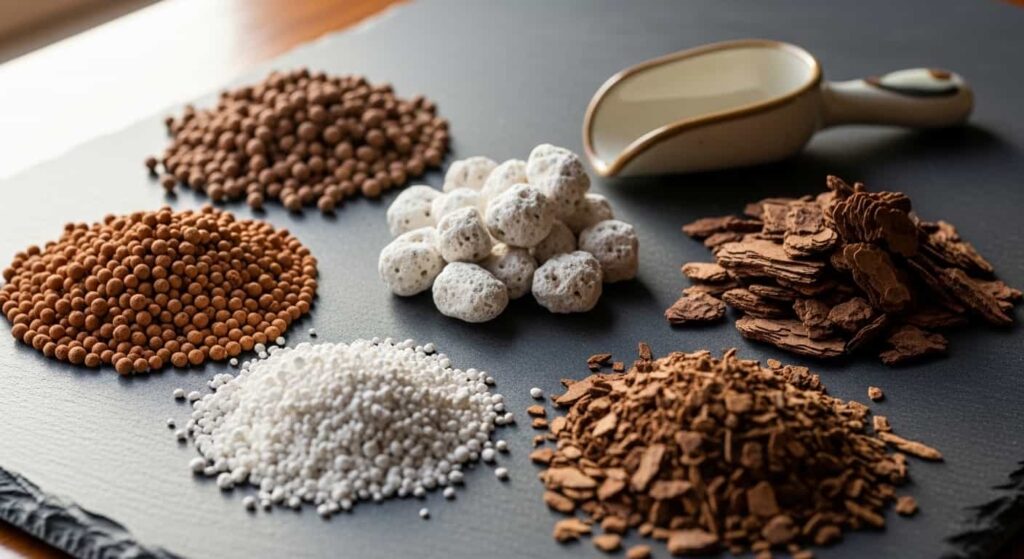
Do not reuse old soil — it is contaminated with fungal spores. Use a fresh bonsai substrate with excellent drainage.
Recommended Ficus Bonsai Soil Mix:
- 60% inorganic material: Akadama, pumice, or coarse perlite
- 40% organic material: Fine pine bark or coarse coco coir
Avoid pure peat-based mixes or standard potting compost — they retain too much moisture.
Repotting steps:
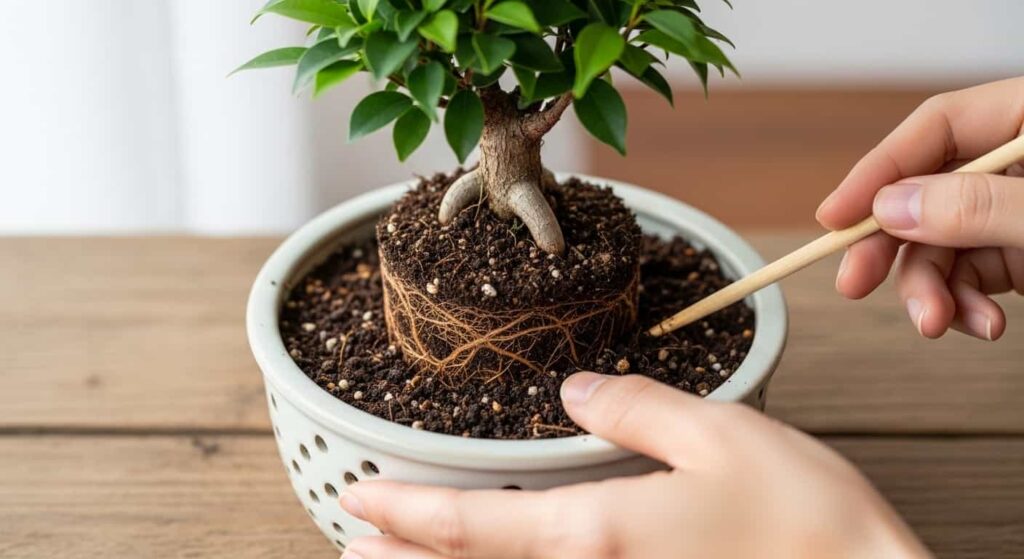
- Add a thin drainage layer of coarse gravel or mesh at the pot bottom
- Place the tree in the pot and spread roots outward and downward naturally
- Fill in with fresh soil, working it around the roots with a chopstick or skewer to eliminate air pockets
- Do not pack the soil tightly — it should be firm but porous
Step 6: Initial Aftercare
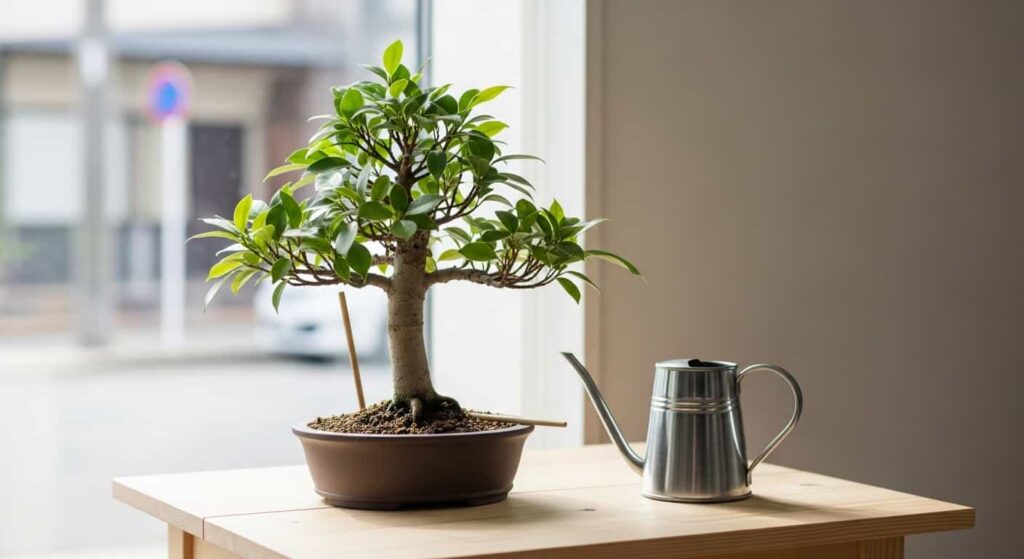
The first 4–6 weeks after repotting are critical.
- Place the tree in bright, indirect light. Avoid direct sun immediately after repotting — the compromised root system cannot handle heat stress.
- Water lightly and carefully. The goal is to keep the soil just barely moist, not wet. Use the chopstick test: insert a wooden chopstick 2 cm into the soil; if it comes out clean and dry, it’s time to water.
- Do not fertilize for at least 4–6 weeks. Fertilizing stressed roots causes fertilizer burn and worsens the situation.
- Maintain warmth. Ficus bonsai prefer temperatures between 18–26°C (65–80°F). Keep away from cold drafts and air conditioning vents.
- Avoid repotting again soon. Give the tree at least one full growing season to recover before any further root work.
Post-Recovery Care: Preventing Root Rot from Returning
Recovery is only half the battle. Without changing the conditions that caused root rot, the problem will recur. Build these habits into your care routine.
Water Based on Soil, Not Schedule

Check moisture before every watering. The top 1–2 cm of soil should be dry before you water again. In winter, when growth slows, water even less frequently.
Use the Right Pot
Ensure your pot has at least two drainage holes. If using a decorative pot, place your bonsai in a functional nursery pot inside it, and empty the saucer within 30 minutes of watering.
Refresh Soil Every 1–2 Years
Bonsai soil breaks down over time, losing its granular structure and drainage ability. Repot your ficus bonsai every 1–2 years with fresh substrate to maintain healthy drainage.
Ensure Adequate Light

Ficus bonsai need bright, indirect light for at least 6 hours a day. More light means faster soil drying and a healthier, more vigorous root system. A south- or east-facing windowsill is ideal.
Improve Air Circulation
Do not enclose your bonsai in tight corners or against walls. Gentle air movement around the pot helps soil dry more evenly and discourages fungal growth.
Seasonal Adjustment
Reduce watering frequency in autumn and winter as growth slows and water uptake decreases. Increase frequency in spring and summer during active growth.
When to Consider Propagation Instead

If root inspection reveals that more than 75% of the root system is rotten and the trunk is soft or blackened at the base, recovery of the original plant may not be realistic. In this case, consider:
- Air layering — Select a healthy branch above the affected zone, girdle the bark, wrap with moist sphagnum moss, and cover with plastic. Roots will develop in the moss. Once rooted, sever and pot as a new tree.
- Cuttings — Take 10–15 cm semi-hardwood cuttings from healthy branches, treat with rooting hormone, and place in a perlite/coco coir mix in a humid environment.
This preserves the genetics and aesthetics of your original tree even when the parent cannot be saved.
Frequently Asked Questions

Can a ficus bonsai recover from root rot?
Yes — if caught early enough and treated correctly, many ficus bonsai recover fully. Trees with mild to moderate root rot (under 50% affected) have a good prognosis with proper treatment. Severe cases are more difficult but not always hopeless.
How long does recovery take?
Expect 6–12 weeks before you see clear signs of new growth, and a full growing season (4–6 months) for the tree to regain vigor. Do not be alarmed by further leaf drop in the first 2–3 weeks after repotting — this is normal as the tree adjusts.
Should I use fungicide as a preventive measure?
Routine fungicide use is not necessary for healthy trees with good care practices. However, after treating root rot, a single application of copper fungicide at repotting is a sensible precaution.
My ficus dropped all its leaves — is it dead?
Not necessarily. Ficus are notorious for dropping all leaves in response to stress. Scratch the bark gently with your thumbnail — if the tissue underneath is green and moist, the tree is still alive. Bare branches with green tissue can produce new leaves as conditions improve.
How often should I repot my ficus bonsai?
Young, vigorous ficus bonsai benefit from repotting every 1–2 years. Older, more established trees can go 2–3 years between repottings. Always repot in spring at the beginning of the growing season.
Conclusion
Root rot in ficus bonsai is serious, but it’s not a death sentence — especially when you act fast. The key is regular inspection, immediate action at the first warning sign, and building a care routine that prevents soggy soil from ever becoming the norm.
Check your soil moisture before every watering. Use a well-draining substrate. Give your tree adequate light. These three habits alone will protect most ficus bonsai from ever experiencing root rot.
If you’ve already spotted the signs, don’t wait — unpot your tree today, assess the damage honestly, and give it the recovery treatment it deserves. Trees are remarkably resilient when given the right conditions to heal.