
Last Updated on March 16, 2026 by Indoor Plant Nook
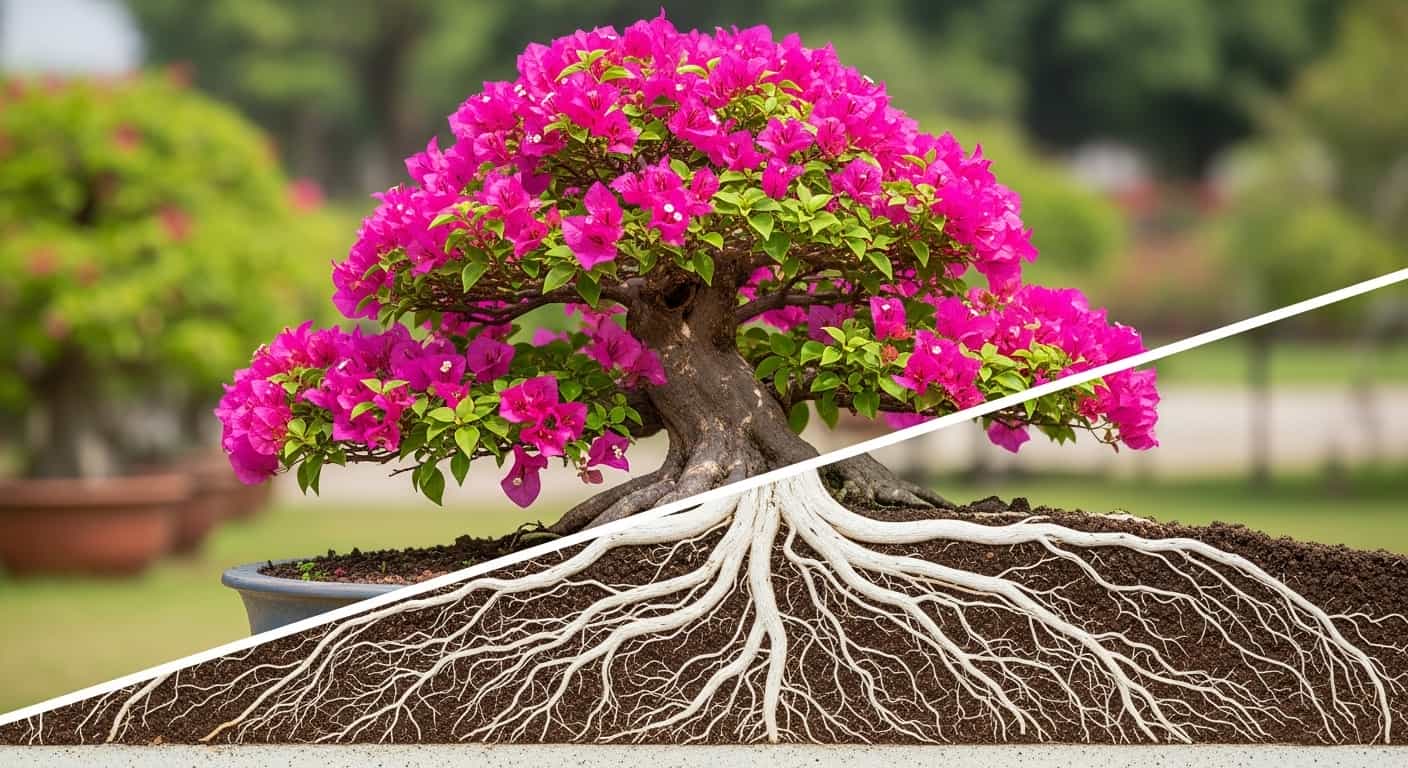
Bougainvillea bonsai are prized for their explosive color, rugged trunks, and forgiving nature — but without proper root management, even the most stunning specimen can stall, decline, or die. Root pruning is the secret behind a healthy, well-balanced bougainvillea bonsai. This guide covers everything you need: when to prune, how to do it safely, what tools to use, and how to care for your tree afterward.
Why Root Pruning Matters for Bougainvillea Bonsai
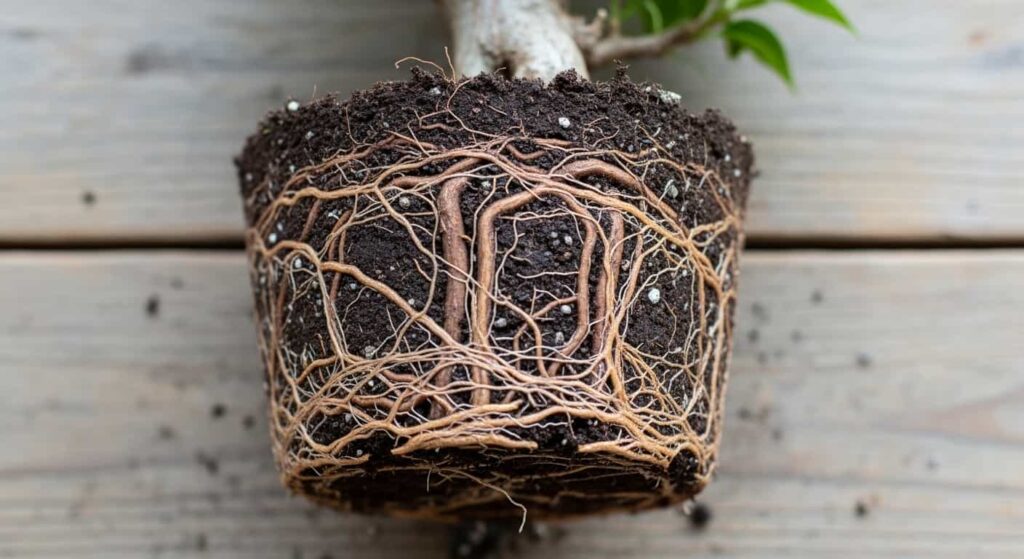
Roots do more than anchor a plant — they drive growth, nutrient uptake, and long-term vigor. In a bonsai container, roots quickly exhaust the available soil space. Left unmanaged, they become pot-bound, circling tightly and strangling themselves. The consequences are real:
- Reduced nutrient absorption as roots compete and decay
- Poor drainage from compacted, root-filled soil
- Stunted top growth due to an imbalanced root-to-canopy ratio
- Increased disease risk from anaerobic, waterlogged conditions
For bougainvillea specifically, root pruning also stimulates the bloom cycle. This is a plant that flowers in response to controlled stress — tightening the root zone at the right moment sends a signal that encourages prolific flowering.
When to Prune Bougainvillea Bonsai Roots
Timing is everything. Prune at the wrong time, and you risk killing a tree that would otherwise thrive for decades.
Best Time: Early Spring (Just Before New Growth)
The ideal window for root pruning bougainvillea bonsai is early spring, right as the first signs of budding appear. At this stage:
- The tree is waking from its semi-dormant winter rest
- Root regeneration capacity is at its seasonal peak
- New feeder roots establish quickly in fresh soil
- The risk of heat stress (which slows recovery) is low
In warmer climates like USDA zones 9–11, this may fall anywhere from late February through April. In cooler climates where bougainvillea is brought indoors for winter, wait until nighttime temperatures consistently stay above 50°F (10°C) before repotting outdoors.
Can You Root Prune in Other Seasons?
Root pruning outside of spring is possible, but carries a higher risk:
| Season | Risk Level | Notes |
|---|---|---|
| Spring | Low ✅ | Ideal — strong recovery, active growth |
| Early Summer | Medium ⚠️ | Possible if kept shaded and well-watered |
| Late Summer / Fall | High ❌ | Recovery slows; root regeneration declines |
| Winter | Very High ❌ | Avoid entirely; dormant trees heal very slowly |
How Often Should You Root Prune?
For most bougainvillea bonsai, root pruning every 2 to 3 years is the standard cadence. Younger trees in development may need repotting annually. Older, more refined specimens in smaller pots can often go 3 to 4 years between root prunings. Watch for these signs that it’s time:
- Roots visibly circling or emerging from drainage holes
- Water runs straight through the pot without absorbing
- Noticeably slower growth despite regular fertilizing
- Soil has broken down into fine, compacted dust
Tools You Need
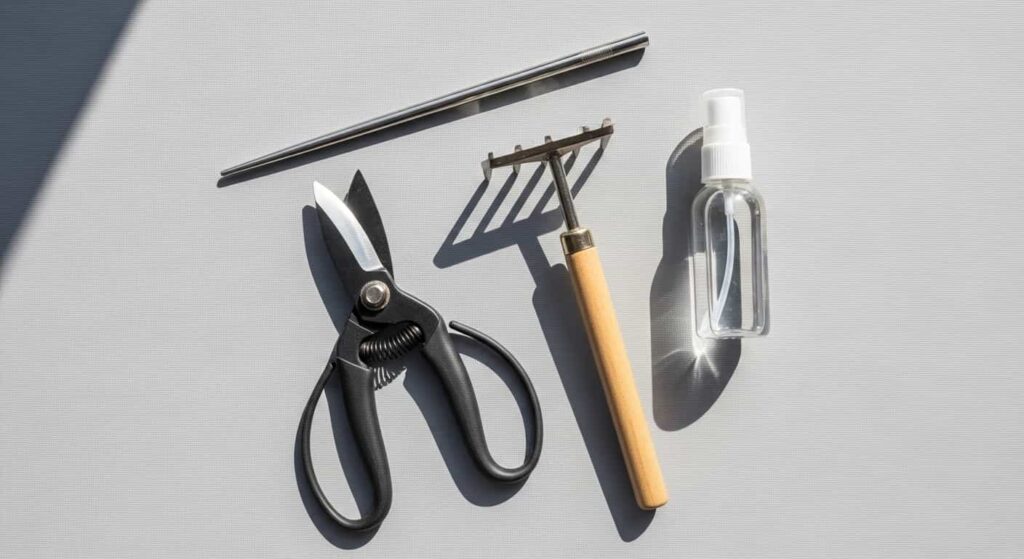
Using the right tools makes root pruning cleaner, safer, and more effective. Bougainvillea roots can be surprisingly tough and woody — dull or improper tools crush rather than cut, leaving ragged wounds that invite rot.
Essential tools:
- Root pruning shears or root hook — for untangling and separating the root mass
- Sharp bonsai pruning scissors — for clean cuts on fine feeder roots
- Heavy-duty bonsai cutters or loppers — for thicker, woodier roots
- Root rake or chopstick — to comb through and loosen roots without tearing
- Concave branch cutters (optional) — for any large anchor roots requiring reduction
- Sterilizing solution (70% isopropyl alcohol or diluted bleach) — clean all cutting tools before use
Soil and repotting supplies:
- Well-draining bonsai soil mix (akadama + pumice + decomposed granite is ideal.
- Drainage mesh/screens for pot holes
- Anchor wire for pot stability (optional but recommended for freshly repotted trees)
- Fresh bonsai pot or the same cleaned pot
Step-by-Step: How to Root Prune a Bougainvillea Bonsai
Step 1: Prepare Your Workspace
Work in a shaded area out of direct wind. Direct sun dries out exposed roots rapidly, and even brief desiccation can kill fine feeder roots. Lay out all tools and have your fresh soil mix ready.
Sterilize all cutting instruments with isopropyl alcohol. This is a simple step many beginners skip — and it’s one of the most common sources of fungal infection in newly repotted bonsai.
Step 2: Water Lightly the Day Before
Lightly water your bougainvillea the day before root pruning. Slightly moist soil (not wet) holds together better during removal and makes it easier to work with the root ball without snapping fragile roots unnecessarily.
Do not water so much that the soil is muddy — saturated roots are harder to assess and more prone to tearing.
Step 3: Remove the Tree from Its Pot
Tilt the pot and gently work the root mass free. For a pot-bound tree, you may need to run a thin blade or spatula around the interior edge to break the seal. Do not yank the trunk — pull from the base of the nebari (surface roots) or tip the pot and ease the root ball out.
Once free, place the tree on a clean, flat surface.
Step 4: Comb Out and Examine the Roots
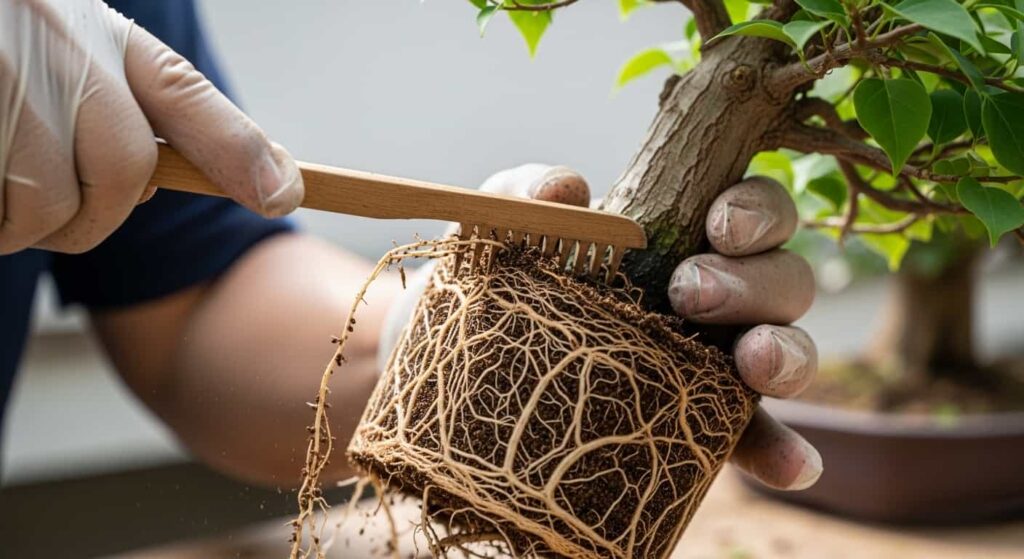
Using a root rake or chopstick, gently comb downward through the root mass to loosen compacted soil and untangle circling roots. Work from the perimeter inward. This process takes patience — rushing it tears healthy roots unnecessarily.
As you comb, examine what you find:
- White or light tan roots — healthy, active feeder roots; preserve as many as possible
- Brown, firm roots — older structural roots; safe to reduce
- Black, mushy, or foul-smelling roots — rot; remove entirely, cut back to healthy tissue
- Circling or kinked roots — straighten or remove to prevent future girdling
Step 5: Prune the Roots
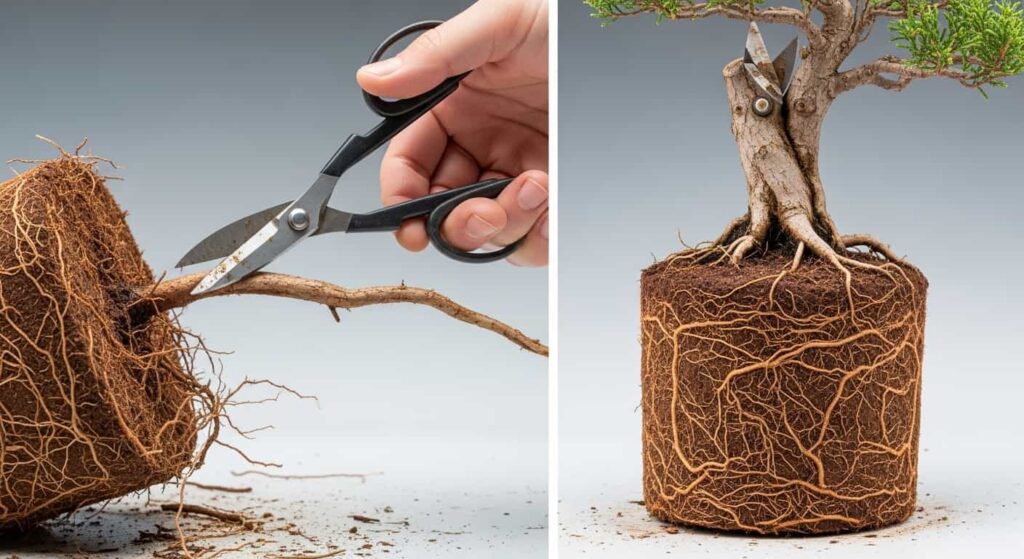
This is the core of the process. The general guideline for bougainvillea bonsai root pruning is to remove no more than one-third of the total root mass in a single session. Aggressive over-pruning stresses the tree beyond recovery.
How to prune effectively:
- Start by removing all dead, rotted, or damaged roots completely — cut back to clean, healthy tissue
- Shorten any roots that are excessively long, circling, or heading directly downward (tap roots)
- Distribute cuts evenly around the root mass — don’t prune heavily on one side only
- Prioritize preserving fine feeder roots near the root ball’s perimeter — these are the tree’s primary nutrient absorbers
- Large, thick roots can be reduced by up to half if necessary, but make clean cuts with sharp loppers
- After each cut on a large root, let it air for a moment before covering with soil — this allows the wound to begin drying slightly, reducing rot risk.
For bougainvillea showing signs of root rot, be more aggressive in removing diseased material. A tree with 40% of its roots removed but all remaining roots healthy will outperform a tree with 90% of its roots intact but rotting.
Step 6: Clean and Prepare the Pot
While the root mass is exposed, clean the pot thoroughly. Scrub with a diluted bleach solution (1 part bleach to 9 parts water), rinse completely, and allow to dry. Cover drainage holes with fresh mesh screens. Lay a thin base layer of coarse soil or drainage aggregate at the bottom.
Step 7: Repot and Position the Tree
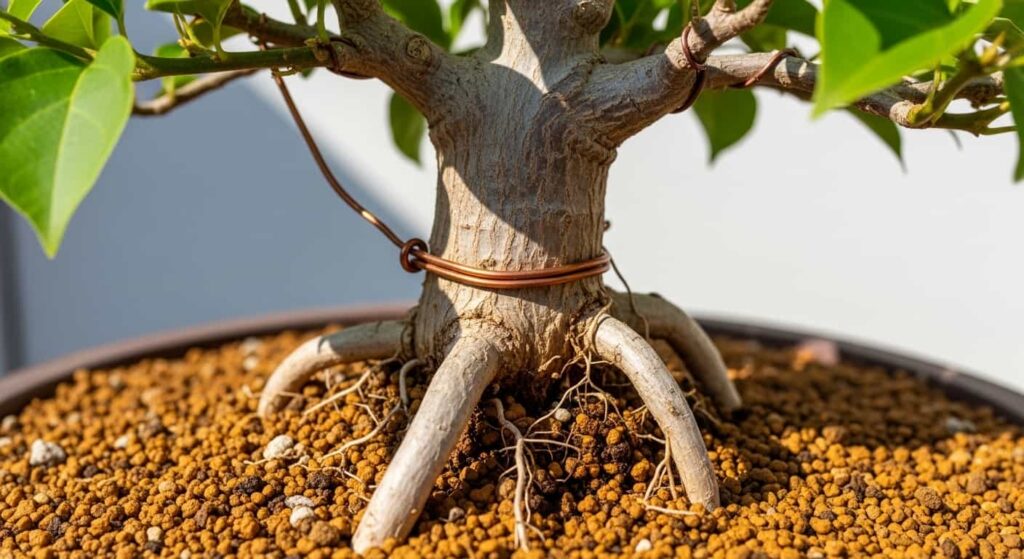
Place a thin base layer of bonsai mix over the drainage layer. Position the tree in the pot — slightly off-center is the classic bonsai aesthetic — and hold the tree at the desired angle and depth. The nebari (base flare) should sit just at or slightly above soil level.
Begin filling in fresh bonsai mix around the roots, using a chopstick to work soil between roots and eliminate air pockets. Air pockets around roots lead to desiccation and death of fine roots — take your time here.
Once filled, press the soil gently but firmly. If the tree is unstable, use an anchor wire threaded through the drainage holes to secure the root mass to the pot. Stability during the recovery period is critical — a shifting tree constantly breaks newly forming feeder roots.
Step 8: Initial Watering
Water thoroughly immediately after repotting, until water flows freely from the drainage holes. This settles the soil, eliminates remaining air pockets, and begins rehydrating the root system.
For the first watering, some growers add a diluted rooting hormone or vitamin B1 solution to reduce transplant shock — this is optional but can speed recovery.
Post Root Pruning Aftercare
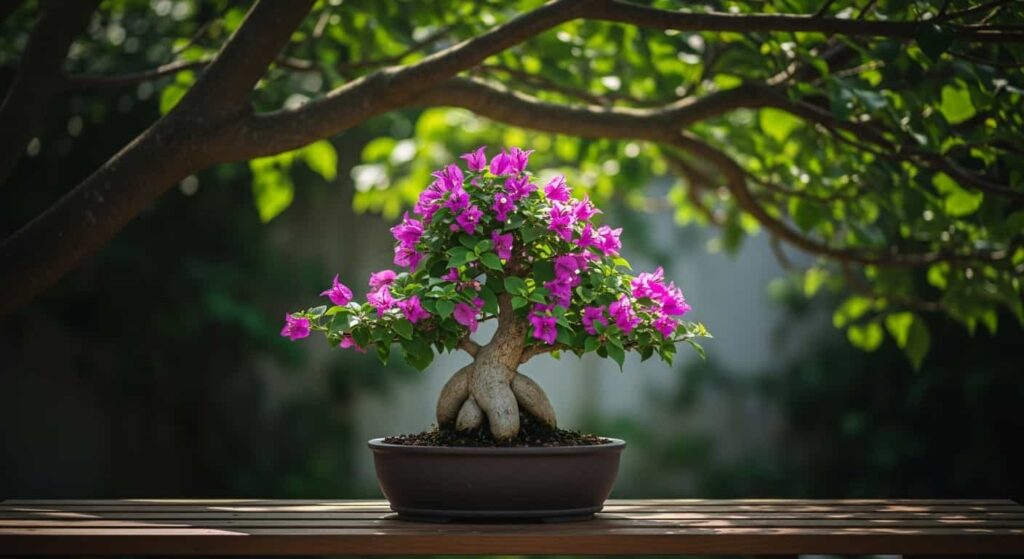
The weeks following root pruning are the most critical period for your bougainvillea bonsai. The tree has a reduced root system and limited capacity to absorb water and nutrients. Treat it accordingly.
Light and Placement
Keep the freshly repotted bougainvillea in bright, indirect light for the first two to four weeks. Avoid full direct sun during this recovery window — the limited root system cannot support the water demands that intense sun creates.
After four weeks and once you observe new leaf growth (a reliable sign of root regeneration), gradually reintroduce the tree to its normal sun exposure. Bougainvillea ultimately thrives in full sun (6+ hours daily), but recovery demands protection first.
Watering After Root Pruning
Water carefully. The fresh soil will retain moisture differently than the old compacted mix, and over-watering a recently root-pruned tree is a leading cause of post-repot death.
Guidelines:
- Water when the top inch of soil begins to dry out
- Never let the soil dry completely in the first month
- Ensure the pot drains freely — standing water causes root rot in the new, vulnerable root system
- Mist the foliage lightly in the morning during the first two weeks to reduce transpiration stress
Fertilizing: Wait at Least 4–6 Weeks
Do not fertilize immediately after root pruning. The exposed root wounds are vulnerable, and fertilizer salts can burn and damage healing root tissue. Wait until you see clear signs of active new growth — typically 4 to 6 weeks post-repotting — before introducing any fertilizer.
Once feeding resumes, start with a half-strength, balanced fertilizer (10-10-10 or similar) for the first two applications, then return to your normal feeding schedule.
Pruning the Canopy After Root Pruning
One of the most effective ways to reduce stress on a recently root-pruned bougainvillea is to balance the equation from the other end — reduce the canopy. Less foliage means less water demand on the recovering root system.
Lightly prune back longer branches by one-third, removing some of the leafy mass. This is not the time for heavy structural pruning — just enough to take pressure off the roots while they regenerate.
Common Mistakes to Avoid
Even experienced bonsai practitioners sometimes slip up with bougainvillea root work. Here are the most common errors and how to avoid them:
Pruning in the wrong season. Root pruning in late summer or fall gives the tree almost no time to regenerate before reduced light and temperatures further slow growth. Spring is the window — plan for it.
Removing too much root mass at once. The one-third rule exists for a reason. Taking more than one-third of the root system in a single session is a gamble — one that frequently results in a severely stressed or dead tree.
Using dull tools. Crushing wounds on roots rather than clean cuts dramatically increase rot risk. Sharpen tools before every root pruning session.
Skipping tool sterilization. Fungal and bacterial pathogens spread from pot to pot on dirty tools. Sterilize every cutting instrument before use.
Place in full sun immediately after repotting. The reduced root system cannot meet the water demands of intense sun. Shade and protection for the first few weeks are non-negotiable.
Over-watering the recovery period. Fresh soil holds moisture differently. Check before watering — moist soil needs no additional water, even if your old schedule calls for it.
Fertilizing too soon. Fertilizer on wounded roots causes a chemical burn. Wait for active new growth before resuming any feeding program.
Special Considerations for Bougainvillea
Bougainvillea has a few unique characteristics that set it apart from other bonsai subjects during root work.
Spine awareness. Bougainvillea has sharp thorns along its branches. Wear thick gloves during repotting — the combination of working around a root ball and maneuvering branches creates many opportunities for painful punctures.
Latex sap sensitivity. Bougainvillea sap can cause mild skin irritation in sensitive individuals. Wash your hands thoroughly after working with the plant.
Drought tolerance vs. root pruning stress. Bougainvillea is famous for drought tolerance — but this applies to established trees, not freshly root-pruned specimens. Do not apply normal drought protocols during recovery.
Bloom stimulation through root restriction. One of the reasons experienced growers value root pruning is its effect on flowering. Slightly restricting the root system — keeping the tree in a snug pot rather than always sizing up — promotes bloom production over vegetative growth. Root pruning done at the right time, followed by good aftercare, often leads to a spectacular flowering display within the same growing season.
Summary: Root Pruning at a Glance
| Factor | Recommendation |
|---|---|
| Best timing | Early spring, just before new growth |
| Frequency | Every 2–3 years (younger trees annually) |
| Root mass to remove | No more than one-third |
| Tools | Sharp bonsai shears, root rake, loppers |
| Post-pruning light | Bright indirect; no direct sun for 2–4 weeks |
| Fertilizing | Resume after 4–6 weeks and new growth appears |
| Watering | Keep moist but not wet; never let it dry completely |
| Canopy | Lightly reduce by up to one-third to balance recovery |
Final Thoughts
Root pruning is not something to fear — it is one of the most rewarding practices in bougainvillea bonsai cultivation. Done at the right time, with the right technique, it renews the tree’s vigor, improves soil health, refines the nebari, and can trigger one of the most dramatic flowering displays your bonsai will ever produce.
Take your time, respect the one-third rule, protect the tree during recovery, and your bougainvillea bonsai will reward you for years to come.