
Last Updated on March 16, 2026 by Indoor Plant Nook
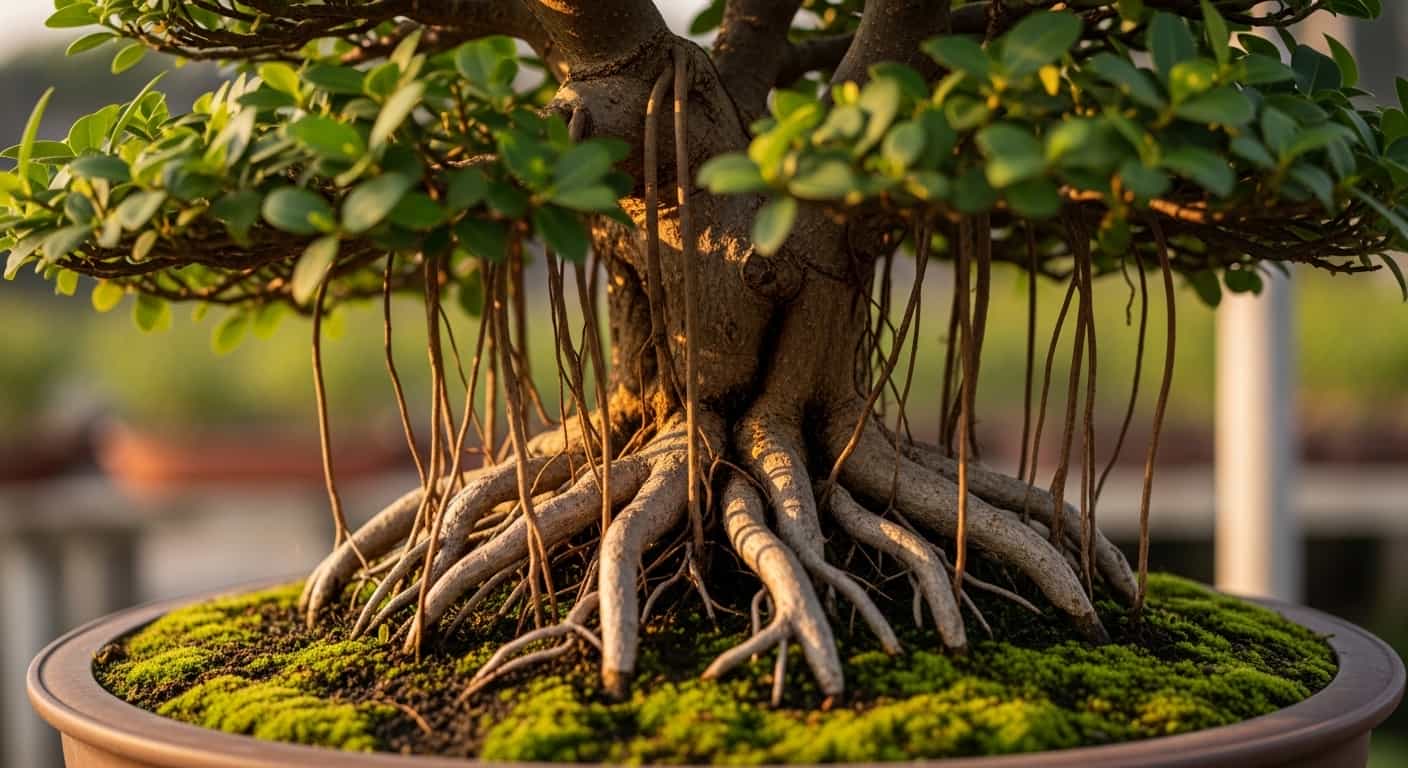
Banyan bonsai (Ficus benghalensis) are among the most dramatic and rewarding trees you can grow in miniature form. Their iconic aerial roots — those ghostly tendrils that drop from branches and thicken into secondary trunks — are what make them look ancient, powerful, and alive. But growing a healthy banyan bonsai isn’t just about aesthetics. Behind every impressive aerial root display is a root system that demands careful attention, the right soil, consistent watering, and periodic maintenance.
This complete guide covers everything you need to know: understanding root types, caring for surface and underground roots, encouraging aerial root development, pruning techniques, and avoiding the most common mistakes.
Understanding the Root System of a Banyan Bonsai
Before you can care for banyan roots effectively, it helps to understand what you’re working with. Banyan trees (and their close relative, the Ficus microcarpa or Chinese banyan) produce three distinct root types, each with a different function.
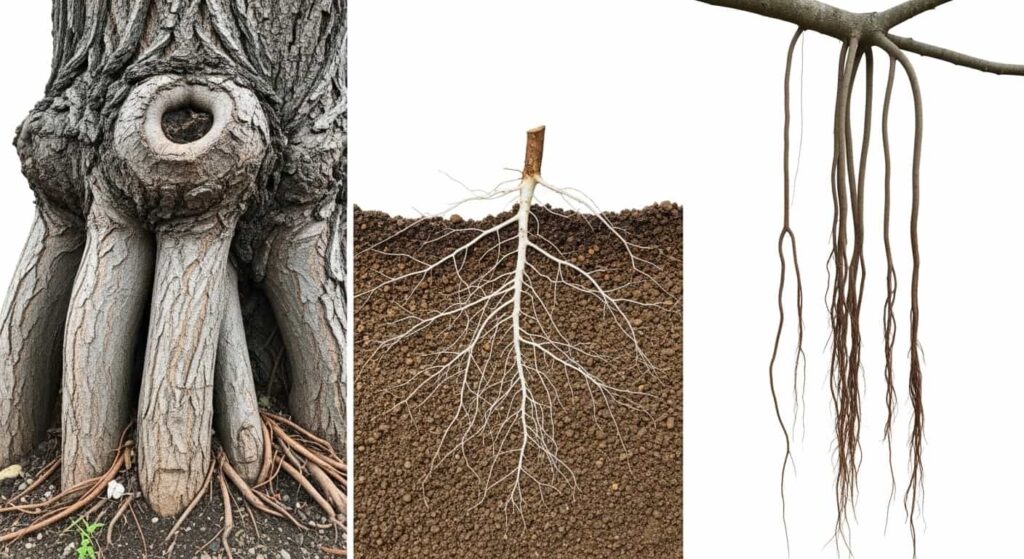
1. Primary Structural Roots (Nebari)
These are the thick, flaring surface roots that radiate outward from the base of the trunk. In bonsai culture, they are called nebari — a Japanese term meaning “root spread.” A well-developed nebari gives the impression of age and stability, anchoring the tree visually to its pot. In a banyan, these roots are typically woody, brownish-grey, and partially exposed above the soil line.
2. Feeder Roots
Fine, white, hair-like feeder roots extend throughout the soil and are responsible for absorbing water and nutrients. These are the most delicate parts of the root system and the most sensitive to overwatering, salt buildup, and rough handling during repotting.
3. Aerial Roots (Prop Roots)
The banyan’s most distinctive feature. Aerial roots emerge from branches and hang downward, drawing moisture from humid air. When they reach the ground and anchor themselves, they thicken over time into secondary trunks — a natural process the tree uses to spread across vast areas in the wild. In bonsai, you can encourage, guide, and train these roots to create breathtaking multi-trunk or curtain-root designs.
Soil Requirements for Banyan Bonsai Root Health
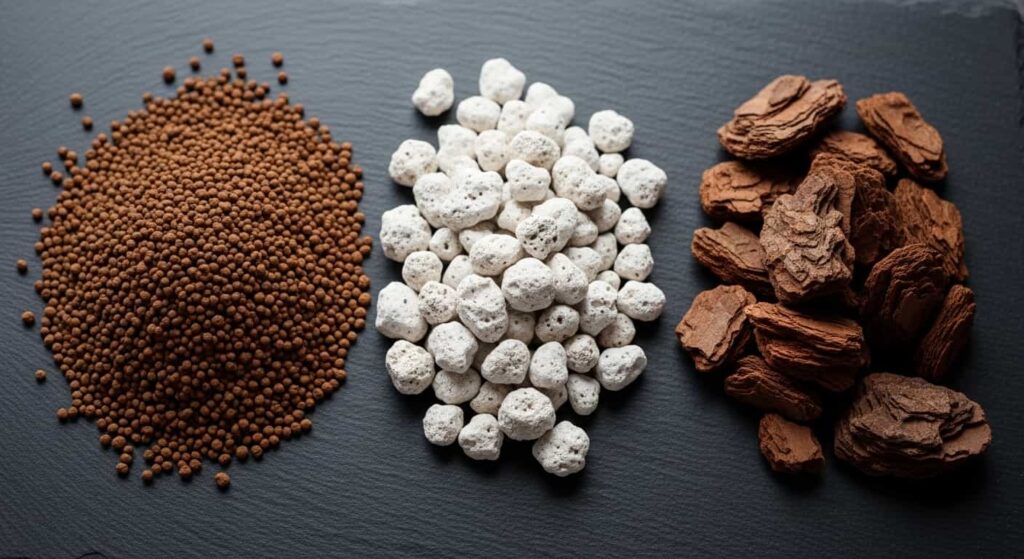
Getting the soil right is the single most important factor in root health. Banyan roots need a mix that balances three things: drainage, aeration, and moisture retention.
Recommended Soil Mix
A well-performing soil mix for banyan bonsai typically consists of:
- Akadama (40%) — A fired Japanese clay that retains moderate moisture while breaking down slowly to improve drainage over time.
- Pumice or perlite (30%) — Provides excellent drainage and prevents compaction.
- Coarse organic material (30%) — Fine-grade bark or decomposed granite adds structure and mild nutrients.
Avoid standard potting soil. It compacts easily, retains too much moisture, and suffocates the fine feeder roots that the banyan depends on for healthy growth.
pH and Soil Chemistry
Banyan bonsai prefer a slightly acidic to neutral soil pH, ideally between 6.0 and 7.0. Water with a high mineral content (hard water) can gradually raise pH and lead to nutrient lockout. If you notice yellowing leaves or stunted growth, test your soil pH and flush with soft water if needed.
Watering Practices That Protect Banyan Roots
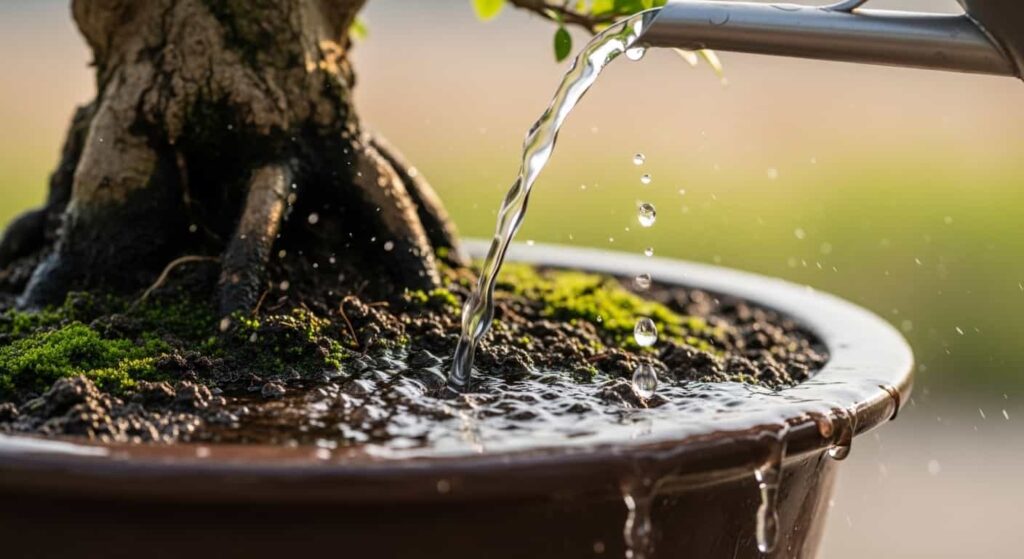
Overwatering is the most common cause of banyan bonsai root rot. Because banyans are tropical trees, many growers assume they need constant moisture — but that assumption kills more banyans than drought ever does.
The Correct Watering Approach
Water your banyan bonsai thoroughly but only when the top 1–2 cm of soil begins to feel dry. When you water, do so until water runs freely from the drainage holes, ensuring the entire root ball is moistened. Then allow the soil to partially dry before watering again.
During active growth periods (spring and summer), you may water every 1–3 days depending on temperature, pot size, and airflow. In winter, or when growth slows, reduce watering significantly.
Signs of Root Problems from Incorrect Watering
| Symptom | Likely Cause |
|---|---|
| Yellow, dropping leaves | Overwatering or root rot |
| Wilting despite moist soil | White crust on the soil surface |
| Crispy leaf edges | Underwatering or low humidity |
| White crust on soil surface | Salt buildup from hard water |
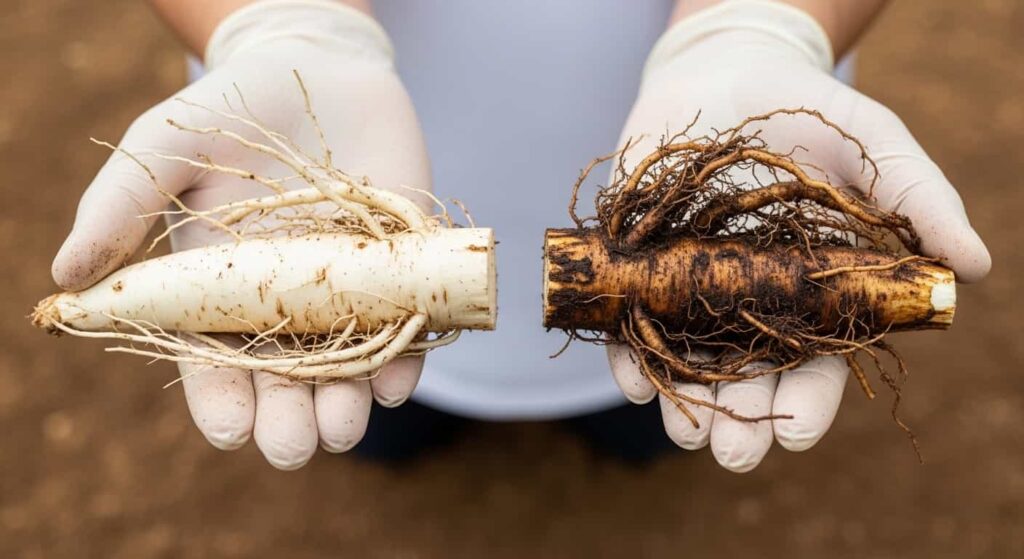
| Mushy, dark roots | Root rot (immediate action needed) |
If you suspect root rot, remove the tree from its pot, trim all black or mushy roots back to healthy white tissue, dust with a fungicide powder, and repot into a fresh, well-draining mix. Allow the soil to dry more between waterings going forward.
How to Encourage and Grow Aerial Roots on Banyan Bonsai
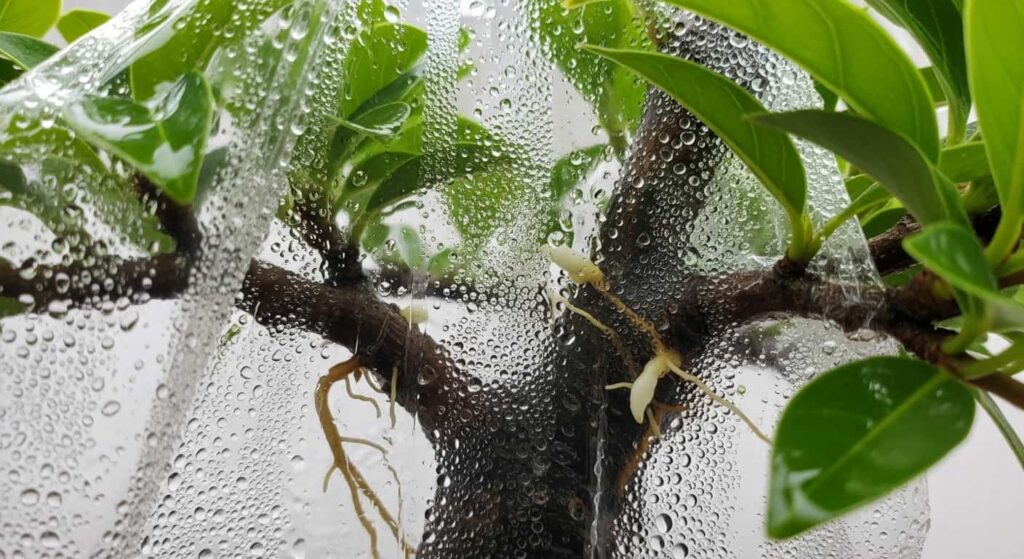
Aerial roots are the crown jewel of banyan bonsai styling, but they don’t grow on demand. They require the right environmental conditions and a degree of patience.
Conditions That Trigger Aerial Root Growth
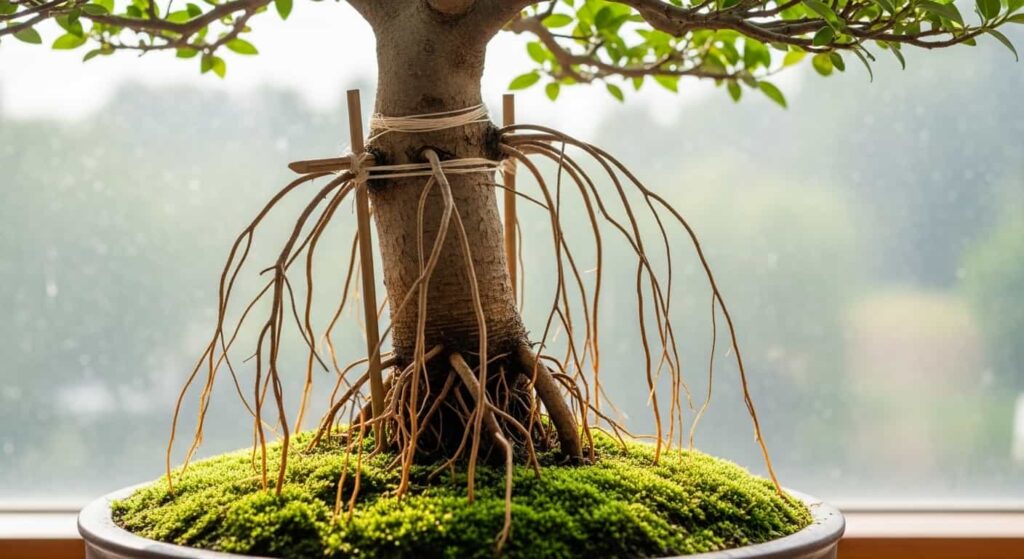
Aerial roots develop in response to high humidity. In their native habitat — tropical and subtropical regions — banyans experience humidity levels of 70–90% for much of the year. To replicate this in cultivation:
Method 1: Humidity Tent. Loosely drape clear plastic wrap or a plastic bag over the branches you want to stimulate aerial roots from. Mist the interior daily. The trapped humidity encourages the tree to initiate root primordia on branches and exposed trunk sections. Check daily to prevent fungal issues and remove the tent for a few hours every couple of days for airflow.
Method 2: Moss Wrapping Wrap sphagnum moss around a branch or trunk area, keep it moist, and aerial roots will often emerge into the moss. This technique is similar to air layering and is very effective during the active growing season.
Method 3: Humid Environment. If you grow your banyan in a greenhouse, terrarium, or humid room, aerial roots may develop naturally without intervention. Placing the tree on a tray of wet pebbles raises ambient humidity around the canopy.
Guiding Aerial Roots to the Soil
Once aerial roots are 3–5 cm long and actively growing, you can guide them toward the soil using small bamboo stakes, wire guides, or thin tubes filled with damp moss. The goal is to direct each root to the soil or into a secondary pot of substrate placed beneath the primary pot.
Once an aerial root reaches soil and anchors itself, it will begin to thicken. This process takes years, but the result — a secondary trunk emerging from what was once a dangling thread — is one of the most satisfying transformations in bonsai.
Tip: Never force or rush aerial root placement. Aerial roots that are bent sharply or knotted may die back. Guide them gently using soft wire or string, and redirect gradually over weeks rather than days.
How Long Does It Take for Aerial Roots to Thicken?
Under ideal conditions (high humidity, warm temperatures, active growth), an aerial root can grow several centimeters per week during summer. Initial thickening into a recognizable secondary trunk typically takes 2–5 years after anchoring. Trees grown outdoors in warm climates develop aerial roots significantly faster than those kept indoors.
Repotting Banyan Bonsai: Root Pruning and Timing
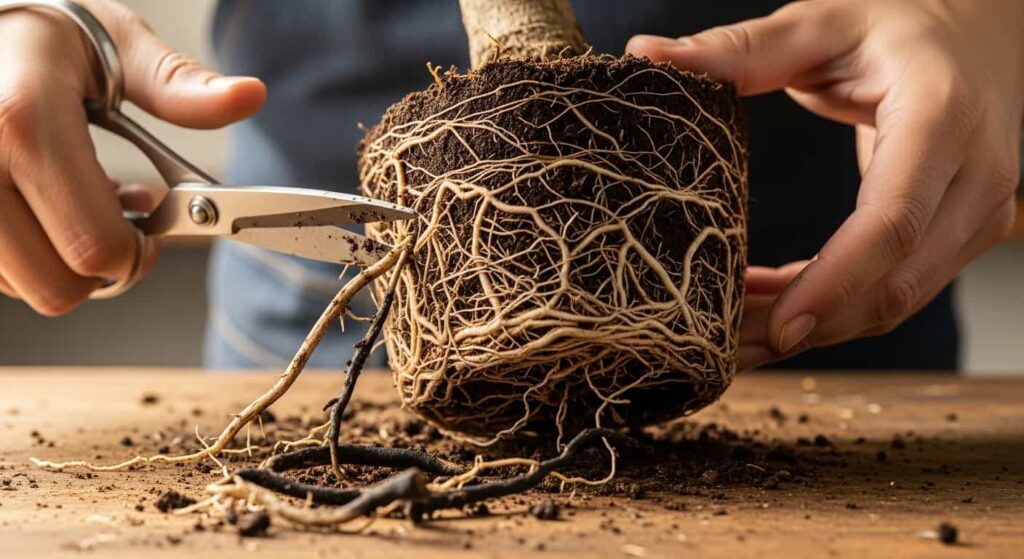
Repotting serves two purposes: refreshing exhausted soil and pruning the root system to maintain the balance between root mass and canopy. For banyan bonsai, this is typically done every 1–2 years for young trees and every 3–5 years for mature specimens.
When to Repot
The best time to repot is early spring, just as the tree begins to show new bud growth, but before the major flush of leaves. At this stage, the tree has maximum energy reserves and will recover quickly from root pruning.
Avoid repotting in winter (when the tree is dormant) or during the peak summer heat, as both increase recovery stress.
Step-by-Step Root Pruning Process
- Remove the tree carefully from its pot. Use a root hook or chopstick to tease the root ball loose without tearing large roots.
- Comb out the roots gently using a root rake or chopstick, working from the outside inward. Remove all old, compacted soil.
- Inspect every root. Trim black, soft, or circling roots with clean, sharp scissors or concave cutters. Healthy roots are white to light tan, firm, and flexible.
- Trim the overall root mass by up to one-third. Remove downward-growing roots to encourage horizontal spread and a better nebari.
- Dust cut ends with powdered sulfur or cinnamon as a natural fungicide.
- Repot into a fresh mix, positioning the tree slightly higher than the pot rim to allow for settling.
- Water thoroughly and place in a shaded, sheltered location for 2–4 weeks while new feeder roots establish.
Nebari Development During Repotting
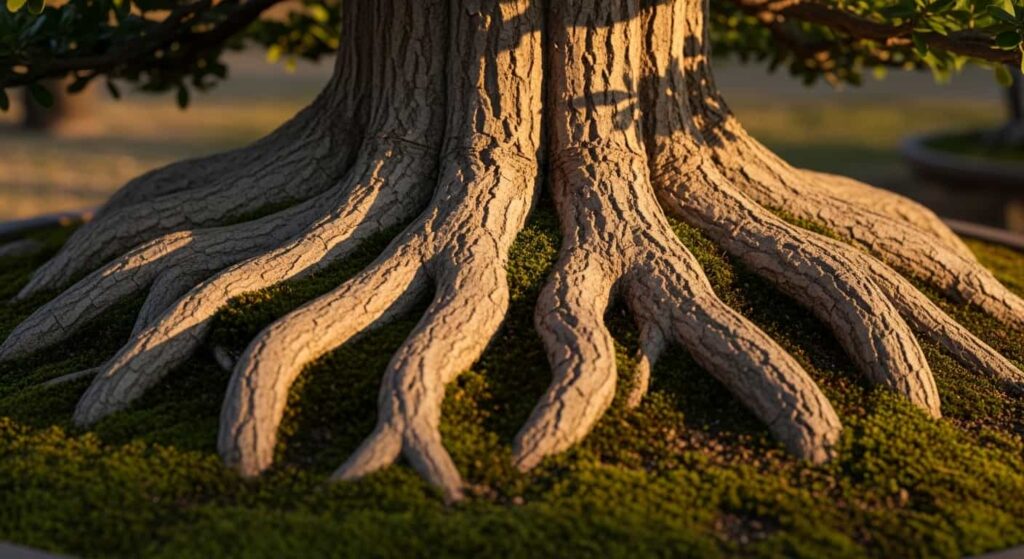
Each repotting is an opportunity to improve your nebari. Look for roots that are crossing, growing in unwanted directions, or sinking straight down. Redirect surface roots outward using small rocks or wooden wedges placed between the root and soil surface, encouraging lateral spread. Over successive repotting, this gradually produces the radial, exposed root base that gives mature bonsai their grounded, ancient appearance.
Fertilizing for Root Development
Roots need nutrients to grow and function. The right fertilization schedule supports both the feeder root network and the development of structural roots and aerial roots.
Fertilizer Recommendations
- Spring and summer (active growth): Use a balanced fertilizer with equal NPK ratios (e.g., 10-10-10) every 2 weeks. Liquid fertilizers are absorbed quickly but flush out fast; slow-release granules provide steadier nutrition.
- Late summer and early fall: Transition to a low-nitrogen, high-phosphorus fertilizer (e.g., 0-10-10). Phosphorus directly supports root development and hardening.
- Winter: Reduce or eliminate fertilizing for trees kept cool or semi-dormant. Trees kept in warm indoor conditions can continue with light feeding every 4–6 weeks.
Avoid over-fertilizing, which can burn feeder roots and cause leaf burn. When in doubt, fertilize at half the recommended strength and observe the tree’s response.
Common Root Problems and How to Fix Them
Root Rot (Pythium, Phytophthora)
Symptoms: Yellowing leaves, wilting despite adequate moisture, and dark, mushy roots. Cause: Consistently wet soil, poor drainage, and overwatering. Fix: Emergency repot, prune all dead roots, repot into fresh, fast-draining mix, treat with fungicide, reduce watering frequency.
Root Bound (Pot Bound)
Symptoms: Rapid water runoff (soil repels water), roots circling tightly inside the pot or emerging from drainage holes, stunted growth. Cause: The tree has outgrown its container. Fix: Repot into a slightly larger container or root-prune and return to the same pot with fresh soil.
Salt and Mineral Buildup
Symptoms: White crystalline crust on soil or pot rim, browning leaf tips, reduced vigor. Cause: Use of hard water or excessive fertilization without periodic flushing. Fix: Flush soil thoroughly with soft or distilled water several times, and allow to drain completely. Reduce fertilizer concentration.
Aerial Root Die-Back
Symptoms: Aerial roots turning brown and shriveling before reaching the soil. Cause: Low humidity, temperature drop, physical damage, or pests. Fix: Increase ambient humidity, protect from cold drafts, and inspect for pests (especially spider mites, which thrive in dry conditions).
Indoor vs. Outdoor Growing and Root Implications
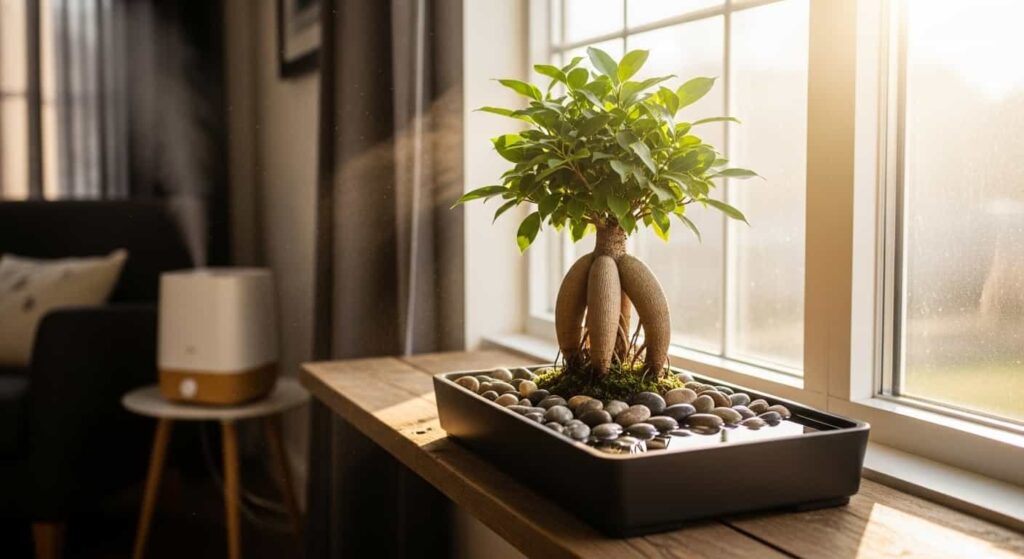
Where you keep your banyan bonsai significantly impacts root health and aerial root development.
Outdoor Growing (Warm Climates)
In USDA zones 10–12 (or similar tropical/subtropical climates), banyans can be grown outdoors year-round. Outdoor conditions — natural rainfall, wind, temperature variation, and seasonal humidity — promote vigorous root growth. Aerial roots develop more readily outdoors in humid climates.
Indoor Growing
Banyan bonsai can thrive indoors if given sufficient light (ideally a south-facing window or supplemental grow lights) and humidity. The main challenges for root health indoors are:
- Low humidity — Use a humidity tray, misting, or a room humidifier.
- Heating and cooling systems — Forced air dries soil unevenly and stresses roots.
- Reduced light — Insufficient light slows root metabolism, leading to overwatering issues even with a careful watering schedule.
Seasonal Root Care Calendar
| Season | Root Care Tasks |
|---|---|
| Spring | Water frequently; monitor for root binding; encourage aerial root growth with humidity. |
| Summer | Water frequently; monitor for root binding; encourage aerial root growth with humidity |
| Autumn | Transition to low-N fertilizer; reduce watering frequency; prepare for slower growth |
| Winter | Minimal watering; no repotting; protect from cold; light feeding if kept warm indoors |
Frequently Asked Questions
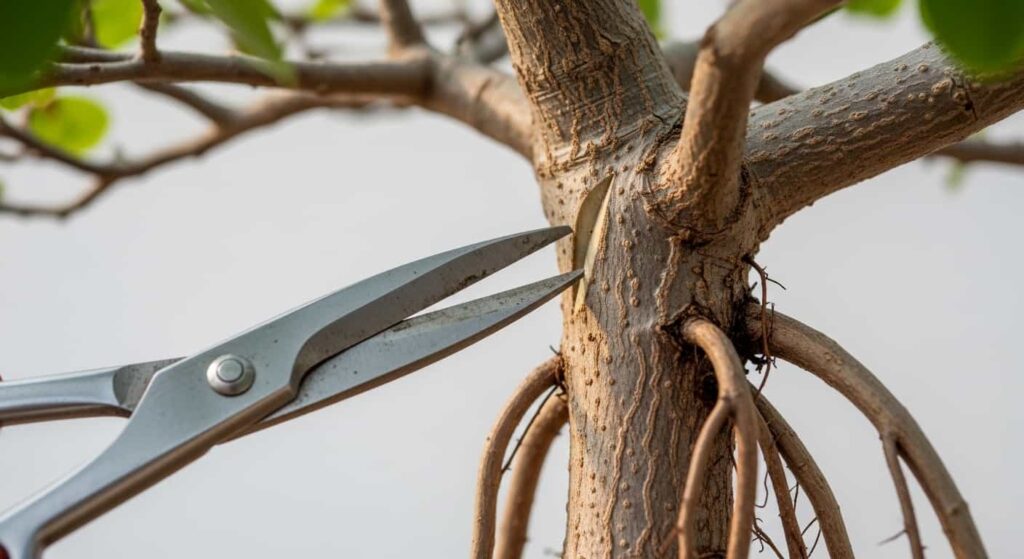
Can I cut aerial roots on my banyan bonsai?
Yes. Aerial roots that are growing in unwanted directions, becoming tangled, or disrupting your design can be trimmed with clean scissors. Cut close to the point of origin if removing entirely, or trim to length if redirecting. The tree will typically generate new aerial roots to replace them.
Why won’t my banyan bonsai grow aerial roots indoors?
Indoor air is almost always too dry to trigger aerial root development. Humidity below 50% rarely produces aerial roots. Try enclosing branches in a humidity tent, misting heavily twice daily, or moving the tree to a bathroom or greenhouse where humidity is higher.
How deep should banyan bonsai roots go in the pot?
Banyans are naturally shallow-rooted. The pot should be deep enough to accommodate 2–4 cm of drainage material at the base plus the root mass, but banyans don’t need or benefit from deep pots. Shallow or drum pots (oval, low-profile) are ideal as they encourage lateral root spread and a better nebari.
What is the best pot material for banyan bonsai root health?
Unglazed ceramic and terracotta pots are preferred by most growers because they are porous — allowing moisture and air to pass through the walls — which helps prevent root rot. Plastic pots retain more moisture and may require less frequent watering, but they also increase rot risk in cooler or less sunny conditions.
Final Thoughts
The roots of a banyan bonsai are its foundation — both literally and artistically. A healthy underground root system powers everything visible above the soil, from the density of the canopy to the vigor of new aerial root growth. And the aerial roots themselves, when properly encouraged and guided, transform a simple bonsai into something that looks like a living cathedral.
Invest time in understanding your tree’s root system, choose the right soil, water thoughtfully, and repot with care. Do this consistently over the years, and you’ll have a banyan bonsai with the kind of powerful, complex root structure that makes other growers stop and ask how you did it.